A single ultrathin artificial skin lets robots sense both temperature and pressure at the same time while matching human tactile perception. How?
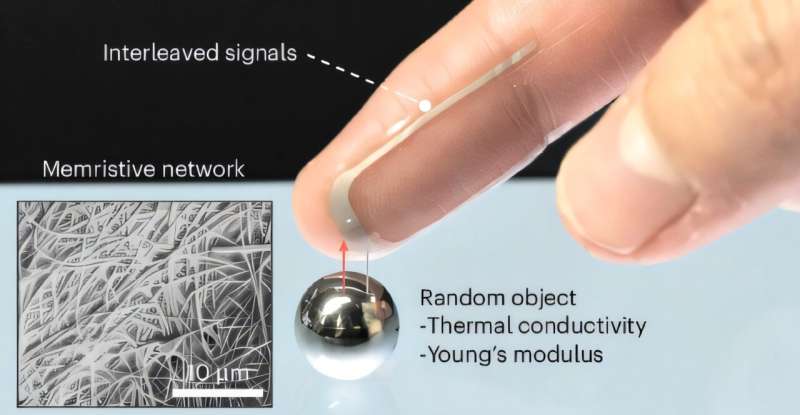
Researchers from Seoul National University have developed an artificial skin technology that enables robots to sense temperature and pressure simultaneously, closely mimicking human tactile perception. The system is designed to support emerging Physical AI concepts where machines interact with the physical world through integrated sensing rather than isolated inputs. This approach addresses a long standing challenge in robotics where multiple sensory channels are usually handled separately, limiting speed and precision.

Traditional multimodal tactile systems rely on stacked or combined sensors, where thermal and mechanical functions are separated into different layers. This increases device thickness, slows response times, and makes it difficult to accurately detect multiple stimuli at the same location. The new approach replaces this complexity with a single ultrathin platform that integrates both sensing functions within one structure, reducing system overhead while improving responsiveness and spatial accuracy.
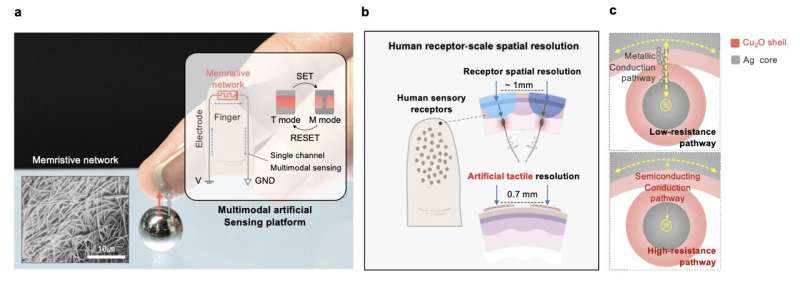
The device is built using a core shell nanowire network composed of a silver core and copper oxide shell. This design allows switching between thermal and mechanical sensing modes within a single layer up to 16 times per second. Mechanical signals are captured at sub microsecond response speeds, while thermal signals are detected at millisecond scale, enabling fast and coordinated sensing. In tests, an AI model using combined signals achieved around 95 percent object classification accuracy across 20 everyday items, improving from about 65 percent using single mode sensing. A fingertip mounted version also reached 83 percent accuracy in real world trials.
Prof. Seung Hwan Ko of Seoul National University College of Engineering’s Department of Mechanical Engineering, states, “This study is significant in that it demonstrates, for the first time, the ability to process both thermal and mechanical stimuli within a single ultrathin device without stacking multiple sensors. We expect this technology to evolve into a core solution for enabling human-level tactile perception in robots and to be widely applied in wearable electronic skin, prosthetics and soft robotics.”