




A new stretchable battery powered by moisture in the air can safely run wearable devices and includes a built-in self-destruct mechanism that destroys electronics if tampering is detected.
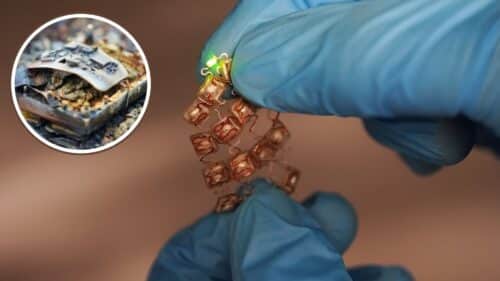
Researchers from Rice University and North Carolina State University have developed a stretchable battery that generates electricity by absorbing moisture from the surrounding air. Designed for wearable electronics and Internet of Things (IoT) devices, the battery removes the need for conventional liquid electrolytes while offering improved safety, flexibility and long-term storage.
The moisture-activated battery (MAB) combines a magnesium anode, a silver/silver chloride cathode and a cellulose membrane infused with lithium chloride salts. Once exposed to air, the membrane absorbs moisture, dissolving the salts to form an electrolyte that enables the battery to produce electrical current. Because it remains inactive in sealed packaging, the battery can be stored for extended periods before use.
Researchers said the design eliminates the toxic and flammable liquid electrolytes commonly found in traditional batteries by effectively operating on salt water. The device continued to function even in low-humidity environments, making it suitable for applications ranging from wearable health monitors and miniature robots to remote sensors.
Unlike many stretchable batteries that rely on serpentine electrical connections, the new design takes inspiration from pangolins. Overlapping, scale-like structures minimise empty space created during stretching, allowing the battery to maintain energy density while bending, twisting and expanding. In testing, it powered a wireless Bluetooth oximeter for up to 30 hours, delivering performance comparable to conventional batteries used in similar devices.
The team also integrated a moisture-triggered “kill switch” designed to destroy electronics if tampering is detected. The mechanism stores aluminium and iodine powder inside a sealed compartment. If the device is opened or damaged, moisture reaches the chemicals, triggering a reaction that generates enough heat to destroy the electronics. In a proof-of-concept demonstration, a wireless gas sensor containing embedded CMOS electronics was completely destroyed within three minutes of activation.
Researchers believe the lightweight, biodegradable and biocompatible battery could provide a safer alternative to lithium-ion technology for flexible electronics, disposable medical devices and secure applications where sensitive data must be protected against unauthorised access.
