When GPS cannot be trusted, a new quantum system could keep satellites and critical systems connected.
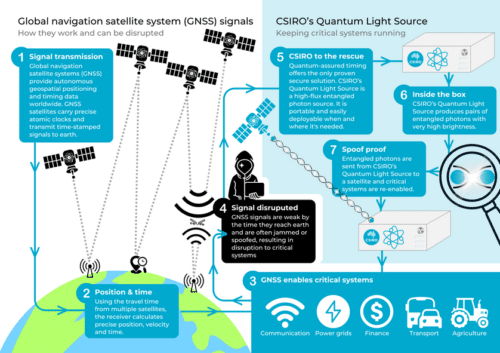
Australia’s national science agency, CSIRO, has developed two portable Quantum Light Sources that move quantum-secured timing closer to practical deployment. The devices are part of a project led by the Defence Science and Technology Group to build a secure timing network that can continue operating when GPS signals are jammed, spoofed, or unavailable.
Modern defence systems and critical infrastructure depend on precise timing to coordinate operations. Conventional GPS-based timing is increasingly vulnerable to interference, creating risks for communication, navigation, power networks, financial systems, transport, and emergency services. The new Quantum Light Sources use quantum entanglement to detect interference, allowing systems to identify compromised links and switch to secure alternatives.
CSIRO designed and built two portable, high-flux entangled photon sources that can be deployed at optical ground stations. These devices generate pairs of entangled photons—particles of light linked through quantum mechanics. During operation, one photon remains on the ground while its partner is transmitted to a satellite. Because the two photons remain quantum correlated, any attempt to intercept or alter the signal changes the quantum state, immediately revealing the interference.
This capability supports quantum-secured ground-to-satellite time transfer, helping maintain accurate timing even when GPS signals are unreliable. The technology is intended to strengthen resilience against both jamming, which blocks satellite signals, and spoofing, which sends false timing or location information to deceive receivers.
Beyond defence, the technology could support civilian infrastructure that depends on accurate timing, including telecommunications, power grids, transport networks, banking systems, and emergency services. By developing the key quantum components locally, CSIRO is also expanding Australia’s capability in secure communications, navigation, and timing technologies.
The project marks an important step toward quantum-secure time transfer in Australia and strengthens the country’s capability to build more resilient positioning and timing systems.