




A newly developed terahertz transceiver combines ultra-low power consumption with a compact design, bringing practical 6G wireless communications a significant step closer to reality.
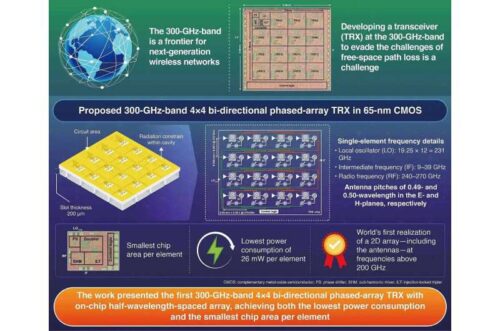
Researchers at the Institute of Science Tokyo have developed a compact chip-based terahertz transceiver designed to accelerate the rollout of future 6G wireless networks. Built using standard complementary metal-oxide-semiconductor (CMOS) technology, the transceiver combines ultra-low power consumption, a highly integrated architecture and high-frequency operation, offering a practical and scalable solution for next-generation wireless communication hardware.
Designed to operate in the 240–270 GHz frequency range, the transceiver targets next-generation wireless systems that require extremely high data rates. The chip integrates antennas, phase shifters, frequency multipliers and bidirectional transmit-and-receive circuitry into a compact footprint, enabling direct wireless communication while reducing system complexity.
The design uses a two-dimensional phased-array architecture with beam steering to direct radio signals towards a receiver. This helps overcome the severe free-space path loss that limits wireless transmission at terahertz frequencies, one of the major technical challenges facing future high-speed communication systems.
During testing, the transmitter supported a 16-Gbaud quadrature phase-shift keying (QPSK) link, while the receiver achieved a 26-Gbaud QPSK link. Each transceiver element consumed only 26 mW of power and occupied a core chip area of 0.30 mm², demonstrating both high energy efficiency and compact integration.
According to the research team, the device is the first fully integrated 300 GHz bidirectional phased-array transceiver featuring on-chip half-wavelength-spaced antennas implemented entirely in CMOS technology. The compact architecture could make future terahertz communication hardware more scalable and suitable for large-scale production.
While further development is needed before commercial deployment, the breakthrough provides a practical foundation for future 6G systems. The researchers believe the technology could support compact, energy-efficient and high-speed wireless hardware needed for next-generation communications beyond today’s networks.


