




A relay board combines four relay channels, Wi-Fi, Bluetooth, and expansion pins for smart home, industrial, and IoT control applications.
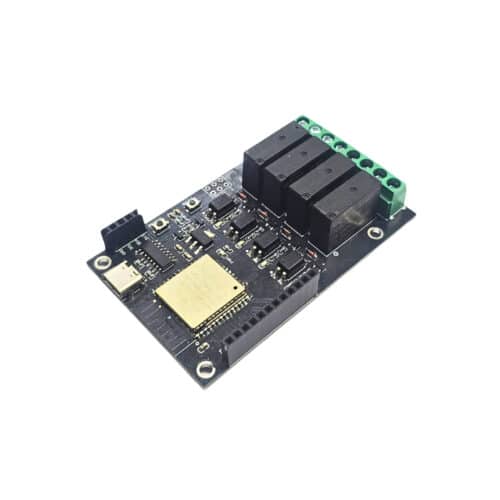
Rajguru Electronics (I) Pvt. Ltd. has launched the ADIY 4 Channel IoT Relay Board, an ESP32-based controller that combines wireless connectivity with four relay outputs for remote switching and automation. The board is designed for applications such as smart homes, industrial automation, remote monitoring, IoT devices, asset tracking, and point-of-sale systems.
The board is built around the ESP32-WROOM-32 module with a dual-core Xtensa LX6 processor. It features four independent relay channels for controlling external AC and DC loads. The relays use low-level triggering and are driven through optocouplers, providing electrical isolation between the ESP32 and high-voltage circuits. PCB isolation slots further separate the high-voltage section from the low-voltage electronics. Each relay supports loads of up to 5A at 250VAC or 30VDC through COM and NO screw terminals.
The board measures approximately 85 × 54 × 15mm, making it suitable for installation inside standard electrical enclosures. It provides a 16-pin GPIO breakout exposing analog and digital I/O pins for connecting sensors, switches, and other peripherals. A dedicated 4-pin I²C header allows direct connection of compatible sensors and displays.
Power can be supplied through a USB Type-C connector or an external 5V screw terminal. An onboard AMS1117-3.3V regulator powers the ESP32 and logic circuitry, while a CH340G USB-to-UART interface supports programming and debugging. The board also includes RESET and BOOT buttons, power status LEDs, and four mounting holes.
The board operates over a temperature range of -40°C to +85°C and complies with RoHS requirements. The ESP32 module carries certifications including FCC, CE, TELEC, SRRC, and IC, while the onboard relays are rated to UL, cUL, and VDE standards.
The IoT Relay Board can be used in smart home automation to control lighting, appliances, and security systems. It is also suitable for industrial automation, including machine control, diagnostics, and process automation. Other applications include IoT devices such as smart meters and remote sensors, point-of-sale systems for relay-based power management and locking, and remote monitoring and control systems that require wireless switching of equipment over Wi-Fi networks.


