


Along with the ongoing FIFA Club World Cup, another football tournament has been pushing the boundaries of technology.
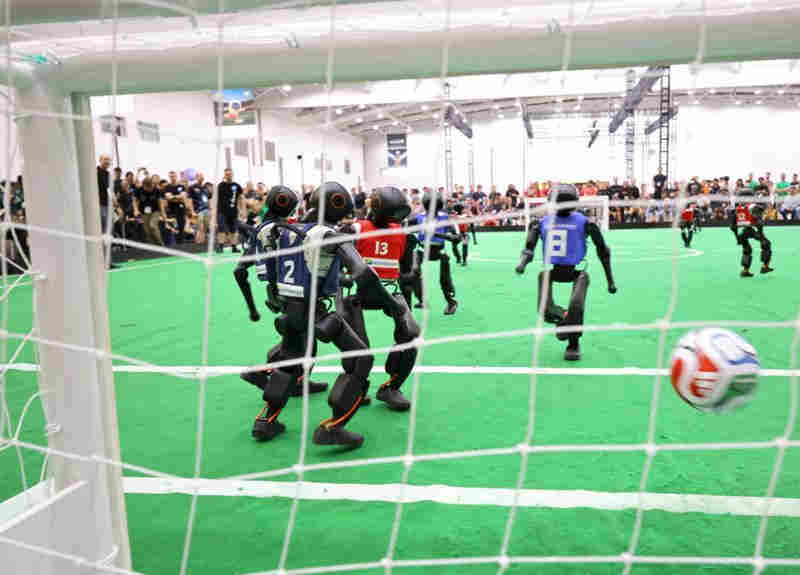
The RoboCup 2026, demonstrated as the first autonomous 11-versus-11 humanoid robot football match is marking a milestone in multi-robot coordination and embodied AI. Held during the RoboCup World Championship in Incheon, South Korea, the exhibition featured two teams of 11 Booster K1 Pro humanoid robots competing in a 45-minute match without human intervention.
The demonstration took place following the official Humanoid Soccer finals, where Germany’s B-Human defeated HTWK Robots 4-0 using autonomous passing strategies developed through deep reinforcement learning. While the exhibition was played on a scaled field designed for 95cm-tall humanoid robots rather than a full-size FIFA pitch, it represented the first time 22 autonomous humanoid robots simultaneously played an organised football match.
Each Booster K1 Pro robot measures approximately 95cm in height and weighs 19.5kg. The platform integrates onboard sensing, computer vision, locomotion control and wireless communication, enabling robots to perceive the field, localise the ball, coordinate with teammates and execute autonomous passing and navigation. AI-based decision-making and reinforcement learning algorithms allow the robots to adapt their positioning and gameplay in real time.
According to the RoboCup Federation, the event reflects continued progress towards the competition’s long-term objective of developing autonomous humanoid robots capable of defeating the human FIFA World Cup champions by 2050. The 2026 championship also marked the first year Booster Robotics’ humanoid platforms became the standard hardware for the competition, with more than 70% of participating teams using the company’s robots for research and algorithm development.
Although current humanoid football remains far from matching human athletic performance, the competition serves as a benchmark for embodied AI, combining perception, balance, motion planning, multi-agent coordination and autonomous decision-making in dynamic real-world environments. The technologies developed for robot football are expected to support broader applications in industrial automation, logistics and service robotics.
Commenting on the exhibition match, Ubbo Visser, President of the RoboCup Federation says, “This match shows how far humanoid robotics has come. We have seen increased teamwork and advanced skills over the years already, but the new humanoid hardware paired with the new level of intelligence provided by AI puts humanoid robot soccer on another level.”