





Can an umbrella think and follow you? This drone-powered prototype can use embedded vision, ToF sensing and Raspberry Pi to stay overhead autonomously.
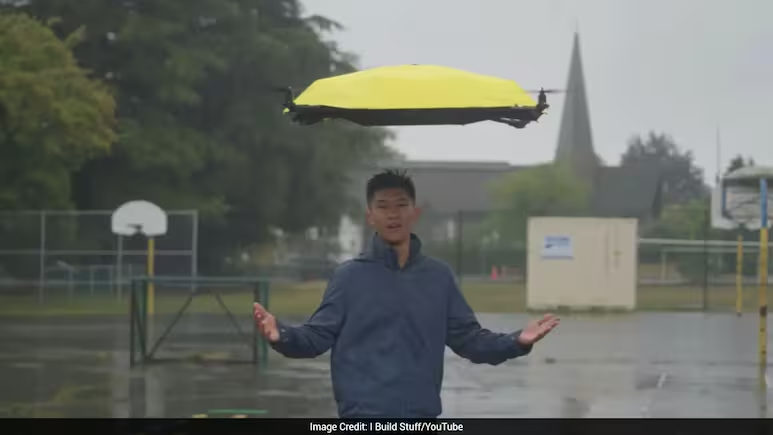
Canadian engineer John Tse has developed a drone-powered autonomous umbrella that uses embedded vision, depth sensing and onboard computing to follow users without manual control. The prototype integrates quadcopter propulsion, a time-of-flight (ToF) camera and a Raspberry Pi to provide hands-free protection from rain and sunlight while automatically maintaining its position above the user.
Unlike a conventional umbrella, the device combines four foldable propellers with a custom internal frame to generate lift while remaining portable. A professional flight controller stabilises the platform during flight, while embedded GPS assists with outdoor positioning. Most structural components, including the hinges, locking mechanism and central hub, are 3D printed using carbon-fibre nylon to reduce weight without compromising strength.
Instead of relying solely on GPS, the umbrella employs a ToF depth camera that creates a three-dimensional map of the user’s position. A Raspberry Pi processes the depth data in real time, identifies the user’s head position and continuously sends commands to the flight controller to keep the umbrella centred overhead. The approach improves tracking accuracy, including under low-light conditions.
Most structural components are 3D printed using carbon-fibre nylon. The system integrates a professional drone flight controller, embedded GPS, custom hinges, locking mechanisms and a central hub that conceals the quadcopter beneath a conventional umbrella canopy. Before integrating the final design, Tse built a smaller test platform to refine flight stability, vibration control and tracking algorithms.
Although the project remains an engineering prototype rather than a commercial product, it highlights how embedded AI, computer vision, additive manufacturing and autonomous drone technologies can be combined to create practical hands-free assistive devices beyond conventional robotics.

