Pressure sensors measure gas, liquid, and frozen media from 2 bars, helping monitor coolant flow in EV battery cooling systems and AI data centres.
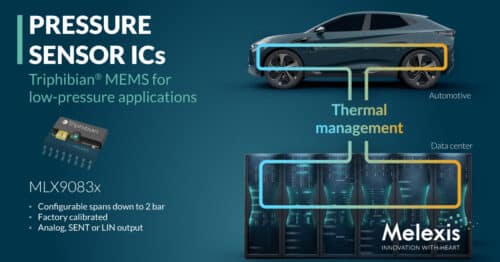
Melexis has expanded its Triphibian pressure sensor family with new low-pressure variants that support configurable pressure measurement from 2 bar. Available for the MLX90830, MLX90833, and MLX90834, the new sensors target applications such as EV battery thermal management systems and liquid cooling in AI data centres.
The variants extend the Triphibian family’s pressure measurement range from 2 to 70 bar. They are available with 2-bar and 4-bar operating ranges, making them suitable for coolant-based systems, including glycol. The sensors can measure pressure in gas, liquid, and frozen media using the same sensing technology, while existing versions continue to support applications such as refrigeration systems and oil pressure monitoring.
The sensors use a suspended-cantilever MEMS sensing element combined with signal processing, conditioning, and an output driver in a factory-calibrated SOIC16 wide-body package. They are designed for direct contact with gas, liquid, and frozen media, eliminating the need for module-level calibration and reducing integration effort.
They can be used as standalone pressure sensing modules or integrated directly into pumps, coolant distribution units, and other equipment. This enables pressure measurement closer to the application while reducing mechanical complexity.
The sensors are factory-calibrated across multiple pressure and temperature points and include overvoltage protection up to +40 V and reverse-voltage protection down to -40 V. They are developed as a Safety Element out of Context (SEooC) under ISO 26262 for systems requiring support up to ASIL B.
The devices are available with analog, SENT, and LIN interfaces. Digital versions also provide on-chip temperature measurement and can connect to an external NTC sensor when both pressure and temperature monitoring are required.
In low-pressure cooling systems, such as EV battery cooling loops and liquid-cooled AI data centres, pressure sensing helps monitor coolant flow, detect faults, and protect system components. Conventional MEMS and ceramic pressure sensors can face challenges when the cooling media changes between gas, liquid, and frozen states, often requiring larger sensor modules and additional calibration. The Triphibian design is intended to address these limitations with a single sensing technology across all three media.
Click here for the original announcement.