A memory chipset supports DDR5 memory at 9600 MT/s, helping AI and server systems move data faster, handle larger workloads, and reduce power use.
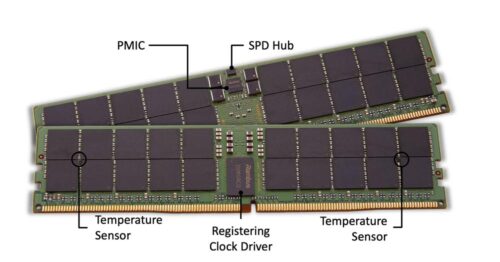
Rambus has introduced the DDR5 9600 Server RDIMM chipset, designed to increase memory performance for AI, high-performance computing (HPC), and cloud servers. The chipset supports RDIMM speeds of up to 9600 MT/s, helping server platforms meet growing demands for memory bandwidth, capacity, and power efficiency.

The chipset is built around the 6th Generation Registering Clock Driver (RCD06), which enables a 20% higher data rate than the previous generation. The increased speed allows faster data transfer between processors and memory, improves utilization of multi-core CPUs, and supports AI inference and HPC workloads. The RCD06 is also designed to maintain signal integrity and stable operation at higher memory speeds.
The DDR5 9600 RDIMM chipset includes the RCD06 Registering Clock Driver, PMIC5030 Power Management IC, SPD Hub, and temperature sensor ICs. These components work together to provide clock management, power delivery, module configuration, and thermal monitoring.
By offering a complete chipset, Rambus aims to simplify RDIMM development, reduce design and validation time for memory module manufacturers, and help server OEMs and cloud providers deploy new memory platforms faster.
The launch comes as AI workloads continue to move beyond model training to real-time inference and autonomous AI applications. These workloads require continuous access to large datasets and place higher demands on memory bandwidth and capacity. At the same time, server processors are increasing in core count and memory channel density, making memory performance an important factor in overall system throughput.
The DDR5 9600 RDIMM chipset is designed to support these requirements by providing higher memory bandwidth for data-intensive applications, larger memory capacity for AI models and datasets, and improved power efficiency for data centers. It is intended for next-generation CPU-based server platforms used in AI, HPC, and cloud infrastructure.
Click here for the original announcement.