A new coating helps LED displays last longer, use less power, and produce colors for TVs, phones, headsets, medical screens, and lighting systems.
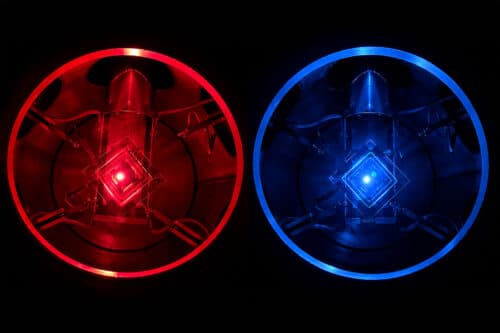
Researchers at MIT and Samsung have developed a way to significantly extend the lifespan of quantum dot LEDs (QD-LEDs), a technology that could improve future TVs, smartphones, AR and VR headsets, medical displays, and lighting systems. By covering QD-LEDs with an acrylate-based resin, the team reduced material degradation during operation, improving both stability and performance.
In testing, the resin increased the lifespan of red QD-LEDs by eight times and improved the lifespan of blue QD-LEDs by more than 5,000 times. Blue QD-LEDs have been the biggest challenge for commercial use because they fail much faster than red and green devices.
Quantum dots are nanoscale semiconductor particles that produce pure red, green, and blue light. They are already used in some high-quality displays, but most current products rely on optically excited quantum dots. Electrically excited QD-LEDs could simplify display manufacturing while reducing power consumption, but their short operating life has limited commercial adoption.
To find the cause of the problem, the researchers sliced QD-LED devices into nanoscale sections and examined them using advanced microscopes. They compared new devices with heavily used ones and found that the material layers inside blue QD-LEDs became thinner, changed shape, and merged together during operation. The team also detected the release of hydrogen and oxygen, which contributed to the damage.
The resin coating reduced the release of these elements and slowed the physical changes inside the device, helping the LEDs remain stable for much longer. While the coating did not remove every source of degradation, it addressed one of the main reasons for device failure.
The research builds on earlier work at MIT that helped establish quantum dot display technology. The team says the findings provide a clearer understanding of why QD-LEDs fail and offer a practical way to improve their reliability.
The researchers now plan to develop additional protective layers to further increase the efficiency and lifespan of QD-LEDs. Beyond displays and lighting, they believe the technology could also be used in sensors, lasers, and other optoelectronic devices.