




Researchers have demonstrated a laser-powered charging system that enables drones to recharge during flight, potentially extending endurance while reducing reliance on frequent battery replacements.
Researchers from the Civil Aviation University of China have developed a laser-powered charging system that could allow drones to recharge while airborne, potentially extending flight times for applications such as infrastructure inspection, disaster response and parcel delivery. The findings, published in the journal Matter & Light, demonstrate a proof-of-concept that converts laser energy into usable electrical power.
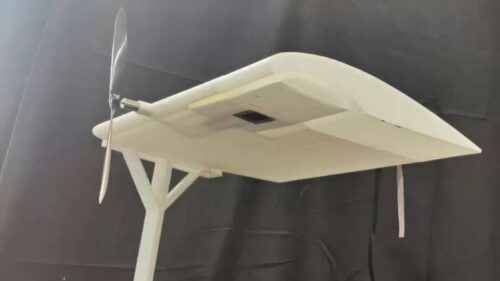
The system uses a lightweight perovskite laser cell-thermoelectric (PLC-TE) tandem device mounted beneath a drone’s wing. Unlike conventional solar cells designed for sunlight, the perovskite layer is optimised to convert laser light into electricity. A thermoelectric layer simultaneously recovers heat that would otherwise be wasted, improving the overall energy conversion efficiency.
Heat management proved to be one of the biggest engineering challenges. During high-power laser testing, device temperatures reached between 80°C and 90°C, reducing efficiency. To overcome this, the researchers embedded specialised nanocrystals into the tandem device, creating a thermal barrier that slows heat transfer while maintaining stable operation during prolonged laser exposure.
Under a green laser, the prototype converted 38.49 per cent of the incoming laser energy into electricity, one of the highest efficiencies reported for comparable laser-powered systems. The team also integrated the receiver into a stationary drone model, where the transmitted laser successfully powered the propeller while airflow beneath the wing further improved cooling and system performance.

Although the technology has yet to be demonstrated on a flying drone, the next phase will involve outdoor flight trials using a lightweight unmanned aircraft. Researchers must also address challenges such as accurately tracking moving drones with laser beams and ensuring operational safety. If these hurdles are overcome, laser-based wireless charging could significantly extend drone endurance and enable longer autonomous missions without frequent battery changes.


