




An experimental hollow-tube extrusion approach could dramatically accelerate large-scale 3D printing while reducing material use, though significant engineering challenges remain before adoption.
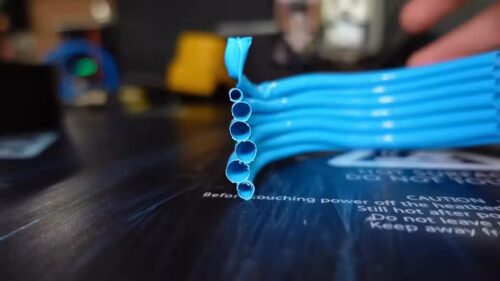
Roetz 4.0 is exploring an unconventional approach to additive manufacturing that could significantly increase 3D printing speeds by replacing traditional solid extrusion lines with hollow plastic tubes. The experimental technique aims to overcome one of the biggest limitations in large-scale 3D printing: the rapid increase in print time and material consumption as object size grows.
Conventional methods typically speed up printing by increasing nozzle size, extrusion width and layer height. While effective to a degree, this produces coarse surface finishes and still requires large amounts of material for solid parts. Roetz 4.0’s concept instead extrudes air-filled tubes, creating structures that are largely hollow while retaining sufficient rigidity through their cylindrical shape.
The experimental system uses a specially designed circular extrusion nozzle with a central air channel. As molten plastic exits the nozzle, compressed air inflates the tube from within, helping it maintain its shape until the material cools. The process combines aspects of extrusion blow moulding with conventional fused-filament 3D printing.
Depending on the ratio of tube diameter to wall thickness, the resulting structures could contain up to 90% air, greatly reducing material usage and potentially allowing much thicker layers to be deposited without the weight penalties associated with solid extrusion. The approach could prove particularly useful for producing large components where fine surface quality is less important, such as boat hulls or industrial structures.

Despite its promise, the technique remains at an early experimental stage. Roetz 4.0 encountered numerous challenges, including balancing nozzle temperature, air pressure and extrusion stability. After extensive testing and tuning, the system was still unable to reliably print a simple single-wall cylindrical vase. The project nevertheless demonstrates an intriguing direction for future research, suggesting that hollow-tube extrusion could eventually offer faster, lighter and more material-efficient large-scale 3D printing if the remaining technical hurdles can be overcome.

