

A new edge-computing platform enables small military drones to process AI locally, improving autonomy, navigation and mission performance while reducing cloud dependence significantly.
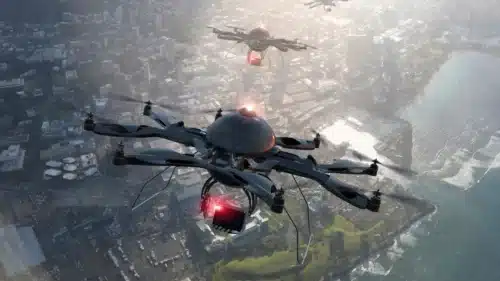
Lantronix and Swarmer have partnered to develop a compact edge-computing platform that delivers up to four times more onboard processing power for small military drones. The new system combines Lantronix’s Open-Q 6490CS System-on-Module with Swarmer’s autonomy software, enabling artificial intelligence to run directly on unmanned aircraft rather than relying on remote cloud computing.
Designed for Group 1 unmanned aircraft systems, the platform aims to improve autonomous operations in environments where communications are unreliable or disrupted. By processing data locally, drones can perform visual navigation, automated target recognition, object tracking and coordinated missions with minimal dependence on external networks.
The increased processing capability is intended to support advanced sensor fusion, real-time decision-making and collaborative behaviour between multiple unmanned systems. According to the companies, the platform is production-ready and designed for deployment across various unmanned vehicles without requiring significant hardware modifications.
The collaboration comes as militaries increasingly seek low-cost autonomous drones capable of operating despite electronic warfare, global positioning system (GPS) disruption and limited communications. Swarmer said its autonomy software has already been used in more than 100,000 combat missions in Ukraine since April 2024, supporting nearly 50 military units in contested environments.
The companies also stated that the platform is designed to meet US national defence authorisation act (NDAA) compliance requirements, making it suitable for government and allied defence programmes while reducing supply-chain concerns. Its compact architecture is expected to remain in production for more than a decade, allowing future upgrades without replacing the underlying hardware.
By bringing powerful artificial intelligence (AI) processing directly onto small drones, the partnership aims to improve mission reliability, responsiveness and scalability. The approach could enable autonomous aircraft to undertake increasingly complex reconnaissance and defence operations while reducing reliance on vulnerable communication links and remote computing infrastructure.
Click here to view original announcement.