




New AI technology helps humanoid robots perform everyday tasks, adapt to new surroundings, work safely alongside people and collaborate with other robots with very little training.
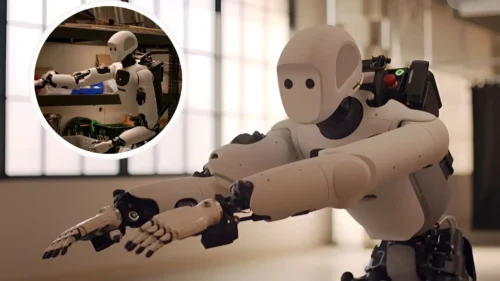
Google has introduced Gemini Robotics 2, a new artificial intelligence model designed to give humanoid robots advanced whole-body movement, improved dexterity and multi-step reasoning capabilities. Building on the earlier Gemini Robotics platform, the latest system enables robots to walk, bend, balance, manipulate objects and complete complex tasks while adapting to unfamiliar environments with minimal retraining.
The company says the model can coordinate multiple robots and transfer its capabilities across different robotic platforms after only a few hours of training. Alongside Gemini Robotics 2, Google has also introduced Gemini Robotics ER 2, a high-level reasoning model, and Gemini Robotics On-Device 2, which runs directly on robots without requiring cloud connectivity.
Unlike conventional robots programmed for repetitive actions, the new models are designed to reason through tasks, adapt to changing situations and execute multi-step workflows. During demonstrations, the system controlled Apptronik’s Apollo humanoid robot, enabling it to pick up objects, move through rooms and place items accurately. It also demonstrated compatibility with other robotic platforms, highlighting its ability to generalise across different robot designs.
Google says the platform improves robotic dexterity by allowing five-fingered robotic hands to perform tasks such as tying trash bags, sealing bags and unscrewing light bulbs. Industrial robots equipped with simpler grippers can also perform precise insertion tasks, tool handling and accurate object placement.
Another major enhancement is multi-robot collaboration. Robots can now communicate, divide work and coordinate actions to complete tasks that would be difficult for a single machine. For environments without internet connectivity, the on-device model enables robots to continue operating locally while adapting to new robot designs using relatively few training examples.
Google has also introduced new safety benchmarks and proximity detection features that help robots recognise uncertainty, seek human assistance when needed and safely slow or stop when people move too close, supporting safer deployment in homes and industrial workplaces.
Click here to view original announcement.

