





A new terahertz oscillation device quadruples output power while retaining its compact footprint, enabling higher-quality sensing, imaging, and non-destructive testing with lower power consumption and simplified evaluation.
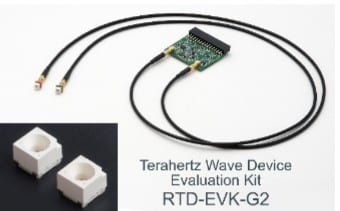
ROHM’s second-generation terahertz wave oscillation device, available through the RTD-EVK-G2 evaluation kit, is designed to accelerate the development of high-performance terahertz (THz) applications by delivering nearly four times the output power of its predecessor. Built on Resonant Tunneling Diode (RTD) technology, the device reaches a maximum oscillation output of 40µW while retaining the same compact chip dimensions, making it suitable for next-generation sensing and imaging systems.
Terahertz waves occupy the spectrum between radio waves and infrared light, combining the penetration capability of radio frequencies with the directional characteristics of light. This enables non-ionizing inspection of materials and precise detection of substances such as polymers and moisture. These properties have driven increasing interest in applications including non-destructive testing, medical imaging, healthcare diagnostics, material identification, moisture detection, and high-resolution radar sensing.
The key features are:
- Maximum oscillation output of 40µW
- 0.5 × 0.5mm RTD chip architecture
- Available through RTD-EVK-G2 evaluation kit
- Compatible with existing 4.0 × 4.3mm PLCC package
- Supports both oscillation and evaluation in a compact setup
Unlike conventional terahertz generation systems that typically require bulky equipment, cooling infrastructure, and high implementation costs, the new RTD-based device is designed for compact, low-power operation. The semiconductor architecture generates less heat than alternative THz generation methods, simplifying system integration and reducing development overhead for laboratories and industrial developers.
Although the chip size remains unchanged at 0.5 × 0.5mm, ROHM redesigned the internal RTD structure to significantly increase oscillation output. The enhanced signal strength improves terahertz wave detectability after transmission through or reflection from target materials, enabling more reliable measurements in applications where signal quality is critical.
The device is housed in a 4.0 × 4.3mm PLCC package, maintaining one of the industry’s smallest footprints for terahertz oscillation devices. This allows engineers to evaluate and integrate THz technology even in space-constrained equipment while preserving compatibility with existing development platforms.
To support product evaluation, ROHM is offering the RTD-EVK-G2 evaluation kit, which includes the second-generation oscillation device, an evaluation board, and connecting cables. The kit enables companies, universities, and research institutions to develop and validate terahertz-based applications without investing in complex laboratory-scale systems. Alongside the new product, the company will continue supplying first-generation RTD devices for applications prioritizing ultra-low power operation.
