A memory standard combines storage capacity and data transfer speed to help AI systems handle growing data workloads.
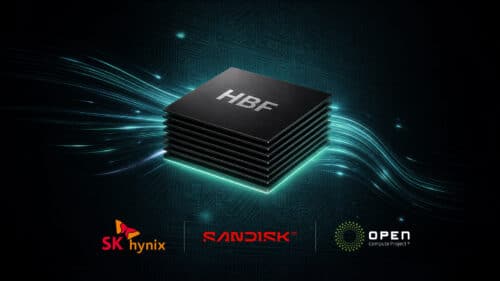
SK hynix and Sandisk have released the first standard specifications for High Bandwidth Flash (HBF), a memory technology designed to combine higher storage capacity with faster data access for artificial intelligence (AI) systems.
The specification supports HBF capacities of up to 512GB and bandwidth ranging from about 0.4TB/s to 3.0TB/s. It uses the Universal Chiplet Interconnect Express (UCIe) interface to connect HBF with processors such as graphics processing units (GPUs) and central processing units (CPUs).
HBF is designed to fill the gap between high bandwidth memory (HBM) and solid-state drives (SSDs). HBM provides high bandwidth but has limited capacity, while SSDs provide much higher capacity at lower data access speeds. HBF uses NAND flash to provide more capacity while offering higher bandwidth than conventional storage.
The technology is aimed at AI workloads that are handling growing amounts of data. As AI inference and other workloads process larger datasets, systems need memory that can provide both capacity and bandwidth without relying only on HBM.

The HBF specification defines two NAND die stack configurations: 8-high and 16-high. These configurations support capacities of up to 512GB. It also defines three bandwidth levels, called Grade 1, Grade 2, and Grade 3, covering approximately 0.4TB/s to 3.0TB/s.
UCIe provides the link between HBF and the processor. The open standard is used to connect semiconductor chiplets from different sources. The HBF specification also covers connection interfaces, electrical characteristics, reliability requirements, packaging guidelines for stacked NAND dies, and software input/output requirements.
SK hynix and Sandisk plan to expand the HBF ecosystem by working with other companies on compatible processors, memory products, and system technologies. The companies also plan to continue developing and standardising the technology.
SK hynix sees HBF as part of a tiered memory architecture for AI systems. In this approach, different types of memory are used for different workloads based on their capacity and performance requirements, rather than relying on a single memory technology across the system.