

A fully playable DOS solitaire game squeezes into just 3 KB, small enough to be shared through a printed QR code and loaded onto compatible hardware.
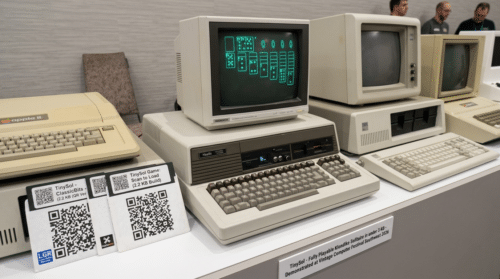
Retro-computing developer ClassicBits has created TinySol, a fully playable Klondike solitaire game for Disk Operating System (DOS) personal computers (PCs). The main version occupies 3 KB as an assembly-language binary, while a 2.2 KB build was small enough to be encoded into a QR code. YouTube channel Lazy Game Reviews (LGR) demonstrated the game at the Vintage Computer Festival Southwest 2026, where TinySol was also distributed on floppy-disk sleeves featuring the QR code.
TinySol is written in hand-coded x86 assembly, allowing its developer to control processor instructions and memory use at a very low level. This helps keep the program compact but requires considerably more work than developing the same type of game with a modern programming language and software libraries. The game detects the available graphics hardware and supports colour graphics adapter (CGA), enhanced graphics adapter (EGA) and video graphics array (VGA) modes, including the unusual 640 × 400-pixel display mode found on the AT&T 6300 PC.
The basic keyboard-only version occupies 3 KB, while a 3.5 KB build adds mouse controls and save-and-load support. Both versions include win detection, automatic completion after a game has been won and scoring. ClassicBits says TinySol can run on hardware dating back to the IBM 5150, the original IBM PC.
The game’s small footprint also makes it possible to encode a version of the software in a QR code and transfer it as a printed image. TinySol was additionally distributed on physical floppy disks at the Vintage Computer Festival Southwest 2026, while the project is available for download from the ClassicBits website.
TinySol can run on DOS or through a compatible emulator. The developer tested it with DOSBox, where the CGA, EGA and VGA modes worked, although the AT&T 6300’s 640 × 400 mode is not supported. This provides a way to experiment with the game on a modern computer without needing original DOS hardware.
TinySol demonstrates how a complete playable game can be built within only a few kilobytes by optimising directly at the assembly level. Its compact design also highlights the trade-off between extremely small software footprints and the additional development effort required to achieve them.
For more information, click here.