

A compact embedded vision platform combines real-time AI, camera and audio capabilities to deliver faster, lower-power computer vision without a single-board computer or operating-system overhead.
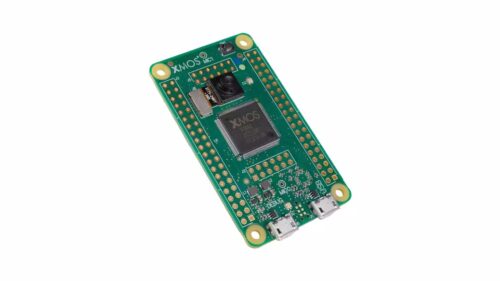
XMOS’ XCORE-VISION is designed to bridge the gap between simple microcontroller-based camera systems and more powerful single-board computers for embedded computer vision applications. Built around the XCORE-AI XU316 multicore microcontroller, the platform can process camera data and run AI models locally in real time without relying on cloud services.
Computer vision projects often require a choice between inexpensive, power-efficient microcontroller boards with limited image-processing capability and more capable single-board computers that introduce an operating system, longer boot times and greater power consumption. XCORE-VISION aims to provide an alternative with greater processing capability and deterministic timing control.
The XCORE architecture supports hardware-level parallel processing and deterministic execution, allowing developers to divide application tasks across processing resources while maintaining predictable operation. This could make the platform suitable for applications where consistent response times are important, including robotics and industrial monitoring.
The platform incorporates an 8-megapixel camera sensor, enabling computer vision development without additional camera hardware. XMOS has demonstrated applications using MobileNetV2 and YOLOv8 for tasks including object classification, face identification, logo detection and image recognition.
Beyond vision, the board includes two digital micro-electro-mechanical systems (MEMS) microphones, enabling multimodal applications that combine visual and audio information. A system could therefore analyse what it sees and hears locally without sending either data stream to another computer.
Additional hardware includes 64 Mbit of quad serial peripheral interface (QSPI) flash, buttons, a light emitting diode (LED), 3.3 V I/O and two Micro universal serial bus (USB) ports. An integrated XTAG4 interface supports programming and debugging.
XMOS plans to make the platform open source, including its schematics and firmware, with documentation and application notes intended to help developers build low-power, real-time vision applications.