




A new semiconductor integration platform combines dense chip packaging, faster interconnects and thermal analysis to tackle key challenges in next-generation AI hardware systems more efficiently.
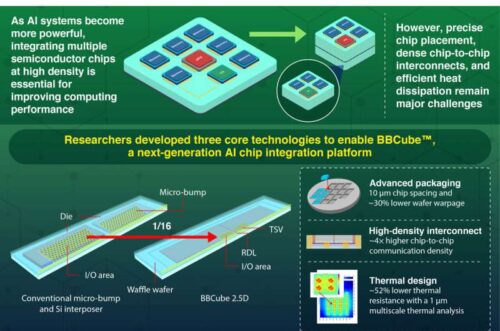
The Institute of Science Tokyo has developed BBCube, a semiconductor integration platform designed to address key challenges in next-generation artificial intelligence (AI) hardware. The approach combines advanced chip packaging, high-density interconnects and improved thermal management, paving the way for more powerful and energy-efficient computing systems.
As AI applications demand increasingly powerful processors capable of handling large volumes of data, integrating multiple semiconductor chips within compact packages has become increasingly important. However, closer chip placement can create challenges involving communication, packaging complexity and heat dissipation.
BBCube brings together three complementary technologies to tackle these limitations. Researchers developed a high-density chip-on-wafer approach that supports advanced two-and-a-half-dimensional and three-dimensional integration. The platform also incorporates bumpless chip interconnection technology, enabling closer chip spacing and faster communication between components.
A further development is a multiscale thermal analysis method capable of evaluating heat distribution across an entire chip at a resolution of 1 micrometre. Using up to 100 million analysis points, the method is intended to provide detailed assessments of thermal behaviour in emerging semiconductor designs.
The research team presented its work at the 2026 IEEE 76th Electronic Components and Technology Conference and the 2026 IEEE/JSAP Symposium on VLSI Technology and Circuits.
Together, the three technologies form an integration platform aimed at overcoming packaging, connectivity and thermal-management barriers in advanced AI hardware. By enabling more compact chip architectures, the work could support faster AI accelerators and high-performance computing systems while improving energy efficiency.
The researchers suggest that continued development of such integration technologies could help meet growing demand for compact, high-performance semiconductor systems as AI hardware becomes increasingly complex.


