

An open-source smartwatch uses a flat electrode array beneath its case to recognise hand gestures without requiring a bulky wrist-worn sensor.
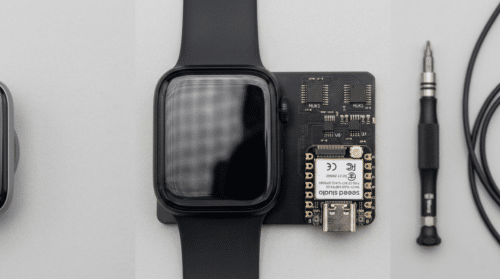
Researchers Xuanyou Liu, Novel Alam and Karan Ahuja from the SPICE Lab at Northwestern University developed EITWatch, an open-source smartwatch design that recognises hand gestures using electrodes integrated into the back of the watch. Unlike wrist-worn gesture systems that require additional hardware around the arm, the design keeps the sensing hardware within the watch form factor. The work was presented at the 2026 ACM Symposium on User Interface Software and Technology (UIST).
EITWatch uses electrical impedance tomography (EIT), which applies small alternating currents through electrode pairs and measures the resulting voltages to detect changes beneath the skin. Eight 2-mm-diameter gold-plated stainless steel electrodes are arranged in a 31-mm ring on a six-layer, 40 × 60-mm circuit board that sits against the back of the wrist inside a standard watch case. The analogue front end uses an AD5930 waveform generator to produce a 50-kHz sinusoidal signal, along with an ADA4841 voltage-to-current driver, AD8220 instrumentation amplifier and AD7450 12-bit analogue-to-digital converter. Four ADG738 eight-channel analogue switches route the measurements between electrode pairs. Movement of muscles and tendons during hand gestures changes the measured electrical impedance, producing patterns that the Seeed Studio XIAO ESP32-S3 can process and classify in real time. The module uses the dual-core ESP32-S3R8 running at up to 240 MHz.
The board collects 35 impedance measurements per frame at a frame rate of 48 Hz. Powered by a 300-mAh battery, the prototype can operate continuously for about 8.6 hours. In testing with the same user during a single session, it recognised six macro-gestures, including a fist and thumbs-up, with 92.5% accuracy. Five smaller micro-gestures, such as a pinch and wrist flip, were recognised with 91.5% accuracy.
Earlier wrist-based EIT systems used electrode bands that surrounded the wrist and connected to separate electronics, making them less suited to conventional smartwatch designs. EITWatch takes a different approach by placing all eight electrodes on the flat rear surface of the watch, keeping the sensing hardware against the skin without requiring an additional wristband. The researchers present this as a way to integrate EIT gesture sensing into a standard smartwatch form factor.
Accuracy falls when the system is tested outside its original training conditions. When tested two days after training, recognition accuracy dropped to 73.2% for macro-gestures and 70.4% for micro-gestures. Testing with a new user without personal training data reduced accuracy further, to 63.1% and 55.3%, respectively. The results suggest that the current system still faces challenges in maintaining recognition accuracy across users and over time. The hardware is released under the CERN Open Hardware Licence CERN-OHL-P-2.0, while the firmware is licensed under Apache 2.0 and uses the ESP-IDF v5.2 framework. The project remains a research prototype rather than a commercially available smartwatch.
For wearable-device developers, EITWatch demonstrates how gesture recognition could be integrated into a smartwatch without adding a separate wrist-worn sensing band. The open-source design provides a reference for researchers and hardware developers exploring compact gesture interfaces, although its current accuracy across users and over time remains a limitation.
For more information, click here.