

A new multi-channel driver delivers precise piezoelectric control for scanners, actuators and transducers, supporting fast, compact motion systems across demanding industrial applications and research environments.
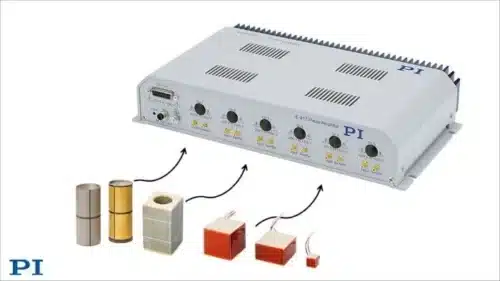
PI (Physik Instrumente) has introduced the E-413 six-channel piezo driver, designed to provide precise control of piezoelectric devices including piezo stacks, scanner tubes, shear actuators and XYZ actuators in static and dynamic applications.
The low-noise driver expands PI’s range of high-precision piezo amplifiers with a compact solution intended for applications requiring multiple channels of high-voltage output. The E-413 amplifier family supports bipolar operation, with peak power of 50W, peak currents of up to 100mA per channel and an output range from -250V to +250V.
PI’s piezo design and manufacturing division, PI Ceramic, provides piezoelectric devices ranging from standard and customised piezo stacks to ultrasonic transducers. The company says its drivers and controllers support applications spanning nanopositioning, nano-dosing, pumping and healthcare technologies.
Piezoelectric transducers can respond within the microsecond range, enabling fast and precise motion. This makes them suitable for high-speed switching, valve control, micromachining, micro-pumping and micro-dispensing. They can also support active optics and vibration-cancellation systems.
The six-channel approach is intended to simplify control of multi-axis piezo devices, tubes, benders and positioning stages while providing several high-voltage outputs from a single unit. Compact driver modules are also available for original-equipment-manufacturer integration.
The technology serves a broad range of industries and applications, including medical engineering, aerospace, laser processing, photonics, research, biotechnology, microscopy, imaging and nanotechnology.
By combining multiple output channels with high-voltage bipolar operation, the driver is positioned as a flexible control solution for systems where rapid, accurate piezoelectric movement is essential. Its compact format could also support integration into equipment where space and electronic control requirements are important considerations.