




Can one battery platform serve homes, businesses, and power grids? Ola Electric is taking its cell technology into three storage systems.
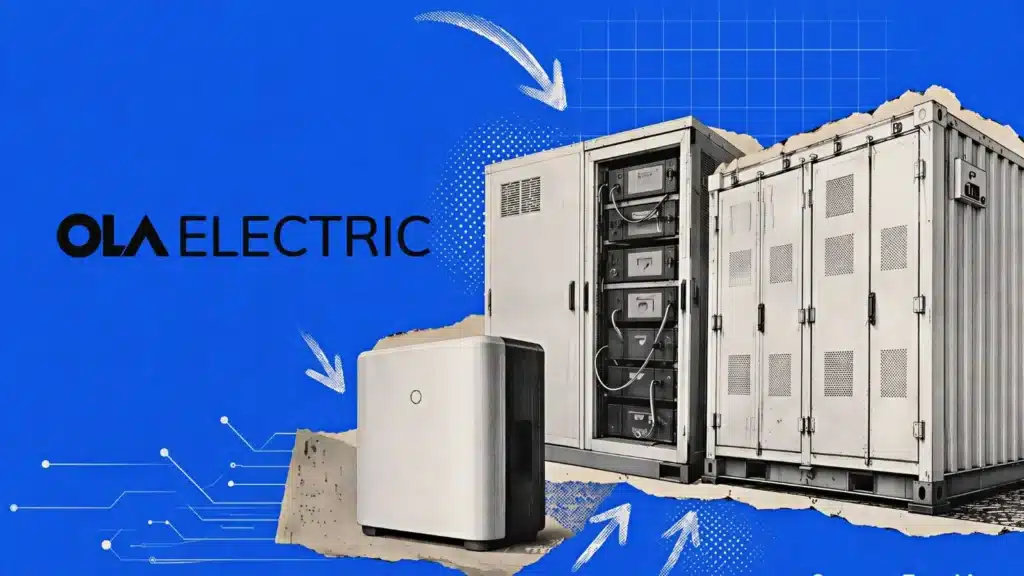
Ola Electric has launched three battery energy storage products under its Ola Energy portfolio, extending its battery technology from electric vehicles into residential, commercial, and utility-scale energy storage. The portfolio includes Ola Shakti, Shakti Rack, and Mahashakti, with each system designed for a different scale of deployment.
The launch expands the company’s use of battery technology beyond mobility as demand for energy storage grows alongside solar and wind generation. Battery energy storage systems can store electricity when generation is available and supply it when required, helping address variable renewable output while supporting backup power, industrial loads, and grid infrastructure.
The residential system, Ola Shakti, is designed for homes and small businesses and uses the company’s 4680 Bharat Cell. It was first introduced in October 2025 and forms the smallest tier of the storage portfolio.
The commercial system, Shakti Rack, targets shops, offices, and small industries, while the utility-scale system, Mahashakti, is intended for renewable energy projects, industrial facilities, grid infrastructure, and data centres. The three systems allow the same cell platform to address different storage requirements.
The company’s Gigafactory is expected to reach 6 GWh of production capacity by September 2026. This capacity is intended to support both electric vehicle production and battery supply for external applications.
For utility-scale deployment, the company has signed a memorandum of understanding with Axis Energy for potential storage deployments of up to 20 GWh by 2032. The proposed deployment could scale to 5 GWh annually from 2028 and support renewable energy projects with grid approvals totalling more than 3,750 MW.
The company has cited estimates that India could require more than 400 GWh of energy storage by 2032. The launch therefore positions its battery platform across residential, commercial, industrial, and grid-scale applications as the country expands renewable generation.
Click here for the official announcement.

