




A sensor measures component movement without touching the surface, including inside systems that face high heat, pressure, and vibration.
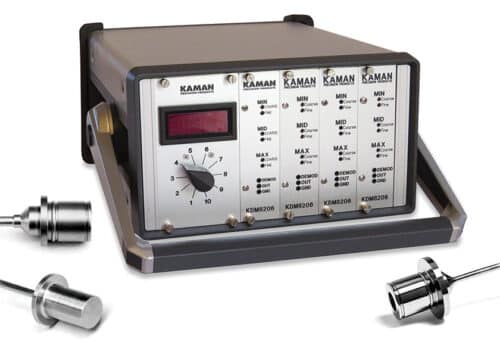
Measuring the movement of components inside a rocket engine, nuclear power system, or high-temperature test setup can be difficult when conventional contact sensors cannot withstand the conditions. KMM Precision Measuring (KMM) offers high-precision displacement sensors designed for such environments, with operation from -320°F to 1000°F, short-term operation up to 1200°F, and pressures up to 5000 psi.
The sensors measure the movement of conductive surfaces without physical contact. This makes them useful for engineers, researchers, and test teams working with high temperatures, high pressures, vibration, and other harsh conditions. The technology was originally developed for NASA and the nuclear power industry and can now be used in applications such as aerospace propulsion, rocket engine turbopumps, power generation, and materials research.
For example, aerospace engineers can use the sensors to monitor the movement of components in rocket engine turbopumps during testing. Nuclear power engineers can measure component movement in high-temperature and high-pressure environments, while materials researchers can study how conductive materials move or change when exposed to extreme temperatures and pressures. The non-contact design is also useful where a conventional contact-based displacement sensor may not survive the operating conditions.
The sensors use hermetically sealed, laser-welded Inconel housings and metal-jacketed, mineral-insulated cables. This construction helps protect them from high temperatures, pressure, vibration, and environmental contaminants.
KMM offers three high-temperature displacement measurement systems. The KD-1925 supports pressures up to 5000 psi, while the KD-1950 and KD-1975 support pressures up to 3500 psi. The systems use KMM’s KDM-8206 signal-conditioning electronics. Single-channel versions are available in NEMA enclosures, bench-top units, and rack-mountable Eurocards. The NEMA enclosure includes an internal power supply, digital panel meter, and window kit, while the rack-mountable version can support up to 12 measurement channels.
The sensors are therefore aimed at applications where engineers need to measure component movement without placing the sensor in direct contact with the surface, particularly in aerospace, nuclear power, energy, and materials research environments.
