




An IP rating can show strong water resistance while leaving a foldable phone’s hinge less protected against fine dust and grit.
Foldable phones can carry impressive water-resistance ratings, but that protection does not necessarily extend to the fine dust and grit that can reach their moving hinge mechanisms. The distinction matters because a foldable phone relies on a mechanical joint that has to move repeatedly while protecting the display and internal components.
An IP rating under IEC 60529 uses two separate digits to describe protection against solids and water. The first digit covers solid-particle protection from 0 to 6, while the second rates water resistance from 0 to 9. An IP68 rating therefore combines the highest level of dust protection with a high level of water resistance. Samsung’s Galaxy Z Fold8 instead carries an IP48 rating, meaning it is protected against solid objects larger than 1 mm but is not certified as dust-tight. Its water-resistance rating remains 8. The two digits work independently, so strong water resistance does not compensate for lower solid-particle protection.
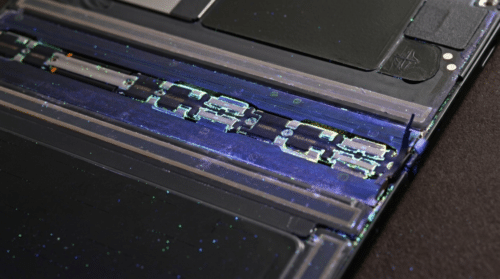
A conventional rigid phone does not need the same type of moving joint. A foldable’s hinge has to accommodate repeated movement, creating mechanical paths that are more difficult to isolate from fine particles. In its Galaxy Z Fold8 teardown, iFixit exposed the phone to UV-reactive dust and found that most of the rigid sections kept the particles out while the hinge accumulated dust. Folding the phone after the test produced a grinding sound and showed how particles could interfere with the mechanism.
The problem has some similarities to the dust-related failures associated with Apple’s earlier butterfly keyboard, where particles could become trapped beneath the low-travel keys and cause sticking or missed inputs. A foldable hinge faces a comparable mechanical challenge: it is a moving assembly inside a consumer device that has to operate repeatedly while remaining exposed to its surrounding environment.
Foldable phones with IP48 ratings are already available in India. Samsung’s Galaxy Z Fold8 starts at INR 1,79,999, while the Galaxy Z Flip8 starts at INR 1,24,999. Both carry IP48 rather than the dust-tight IP6 rating found in an IP68 device. For buyers, this means a high water-resistance number should not automatically be interpreted as complete protection from dust.
When comparing foldable phones, it is worth reading both digits of the IP rating separately. Fine dust can be particularly relevant in environments such as construction sites, dusty roads, beaches and other outdoor locations, where particles can reach moving mechanical components even when water ingress is well controlled.
As foldables become more common in India’s premium smartphone market, hinge durability could become an increasingly important repair consideration outside the warranty period. The point is not that foldable phones are inherently fragile, but that an IP rating represents two separate forms of protection and strong water resistance does not guarantee the same protection against dust.
For more information, click here.

