

A Chinese robotics firm has demonstrated a rideable quadruped machine, highlighting how unconventional robotic designs could expand mobility beyond traditional vehicles for transport and travel.
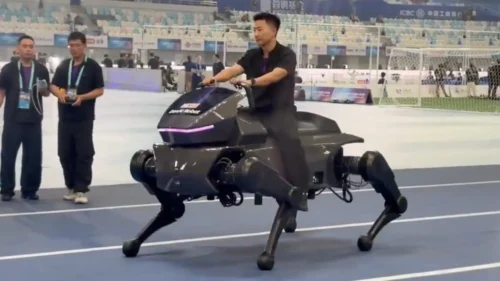
DaxAI Robotics has demonstrated the Qiji X1, a rideable quadruped robot designed to carry a human rider, at the 2026 World Robot Conference in Beijing. The machine combines four articulated mechanical legs with a saddle and handlebars, reportedly supporting loads of up to 660 pounds.
The demonstration highlights how robotics companies are moving beyond conventional industrial machines towards systems designed for transportation, mobility and other human-centred applications. The Qiji X1 is essentially a large four-legged robot adapted to function like a robotic horse, with the rider seated on top and using front-mounted handlebars to control it.
Unlike wheeled or tracked vehicles, the machine moves using four mechanical legs, giving it an appearance closer to an animal than a conventional personal vehicle. Demonstrations showed it moving across the exhibition floor at a deliberate, somewhat unsteady pace, indicating that the technology remains a proof of concept rather than a mature transport product.
DaxAI Robotics developed the machine as an experimental rideable four-legged robot. The Beijing-based company emerged around 2025 and was founded by Wang Kun, who had previously worked on robotics and autonomous driving technology. Co-founder and chief technology officer Xu Wenqiang is described as having an advanced background in artificial intelligence.
The robot was among several machines showcased during the conference, as Chinese robotics manufacturers demonstrated increasingly varied approaches to mobility, dexterity and human interaction. The event also featured the 2026 World Humanoid Robot Games, with robots representing 16 countries.
While the Qiji X1 remains primarily a technological demonstration, its rider-carrying design suggests a broader direction for robotics: developing machines that can operate in environments where conventional platforms may be less suitable. The concept also illustrates growing interest in robotic systems that combine autonomous-machine technology with practical human transport.