Two-component materials are designed to protect automotive sensors, industrial electronics, and equipment used in hazardous areas.
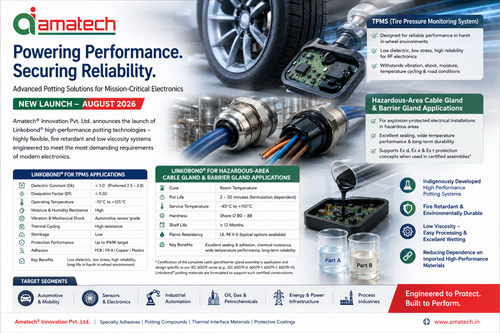
Amatech Innovation has launched the Linkobond 270 Series, a range of two-component potting and encapsulation materials for automotive electronics, sensors, industrial electronics, and electrical equipment used in hazardous areas. The series is initially targeted at Tire Pressure Monitoring Systems (TPMS), automotive sensors, RF electronics, industrial sensors, hazardous-area cable glands, energy and power equipment, and industrial automation.
The materials are designed for applications requiring low viscosity, flexibility, adhesion, flame retardancy, and resistance to moisture, vibration, temperature cycling, and other environmental conditions. They are intended to provide mechanical and electrical protection in applications where conventional rigid encapsulants may not provide the required combination of properties.
For TPMS and in-wheel electronics, the Linkobond 270 Series is designed to withstand vibration, mechanical shock, moisture, temperature cycling, and other conditions inside a vehicle wheel. The development targets include a dielectric constant (Dk) below 3.0, with a preferred range of 2.5–2.8, and a dissipation factor (Df) below 0.02. The target operating temperature range is −10°C to +125°C.
The materials are also designed for low shrinkage and low internal stress, along with resistance to moisture, vibration, and thermal cycling. They can adhere to PCB/FR-4, copper, and engineering plastics. Depending on the application, the protection capability is targeted at IP69K. The low dielectric properties and flexibility are intended to support RF-enabled TPMS electronics and other sensor assemblies.
Another application area is hazardous-area cable entry systems, including barrier cable glands used with explosion-protected electrical equipment. The materials are developed for resin-based sealing applications requiring low viscosity, cable-core wetting, mechanical integrity, and environmental resistance. Depending on the final certified assembly, the technology may support protection concepts including Ex d, Ex e, and Ex t.
Development targets for these applications include room-temperature curing, a formulation-dependent pot life of 2–30 minutes, and a service temperature range of −45°C to +110°C. The materials are targeted at a Shore D hardness of 80–88 and a shelf life of at least 12 months. Flame-retardant formulations, strong adhesion, and moisture resistance are also available as part of the series.