




Johns Hopkins APL has 3D-printed a phase-change heatsink that cuts size and weight by more than half.
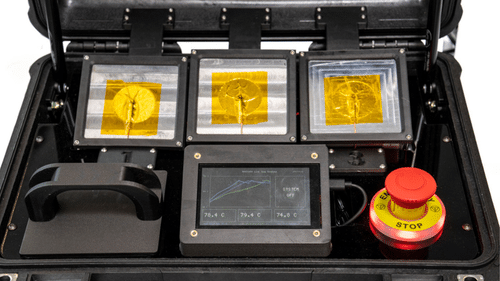
Engineers at the Johns Hopkins University Applied Physics Laboratory have developed a heatsink that is additively manufactured as a single piece with phase-change material sealed inside it. The team reports that the design reduces both size and weight by more than 50 per cent compared with a conventional metallic heatsink offering the same thermal capacity. The project, called SPEAR, short for Smart Phase-change Enhanced Re-entry, is funded through the laboratory’s Research and Exploratory Development programme.
A conventional metallic heatsink absorbs heat by increasing in temperature and releases it through its surface to the surrounding air. Its thermal capacity depends on the properties and mass of the metal, while fins increase the surface area available for heat dissipation. A phase-change material (PCM) heatsink works differently by storing heat through a change of state. As the PCM melts at its transition temperature, it absorbs a large amount of energy as latent heat without a corresponding rapid rise in temperature. This allows a relatively small volume of phase-change material to store thermal energy that would otherwise require a larger mass of metal. The Johns Hopkins APL release does not identify the specific phase-change material used in the SPEAR prototypes.
PCM heatsinks are not new, but manufacturing them as reliable, sealed systems remains an engineering challenge. Conventional designs typically require a metal enclosure to be machined, filled with the phase-change material and sealed, introducing joints and interfaces that can become potential leakage points. Additive manufacturing allows the SPEAR team to produce the outer shell, internal structure and PCM containment as a single integrated body, removing the conventional seams associated with assembled designs. The team reports building initial units in-house and conducting side-by-side tests against conventional heatsinks, with no leaks observed during those tests.
The comparison is with conventional machined aluminium heatsinks, widely used in power electronics because aluminium is relatively inexpensive, thermally conductive and easy to manufacture. However, conventional heatsinks can add significant mass and occupy substantial space in systems where mechanical constraints are critical. Reducing the size and weight of the thermal system by more than half could therefore be significant for airborne, space-constrained and portable hardware. The trade-off is that a PCM heatsink is primarily a thermal-energy storage system rather than a continuous steady-state cooling solution. Once the phase-change material has absorbed its available latent heat and fully melted, it can no longer provide the same thermal buffering until it cools and solidifies again.
This remains a tested laboratory prototype rather than a commercial product. Yoni Ferneau, a mechanical engineer at the laboratory, says PCM heatsinks can be useful in applications where electronics generate large amounts of heat over short periods. The team identifies potential uses in hypersonic systems, spacecraft, radio-frequency electronics, transmitters, interceptors and other transient or low-duty-cycle applications. The emphasis on transient operation is important: the design is intended for systems that experience intense bursts of heat rather than equipment that operates continuously at high temperatures.
Duty cycle is therefore an important filter when considering where this approach could be useful, and several Indian aerospace and defence systems operate under similar intermittent thermal conditions. Radar transmitters and electronic-warfare systems can generate high thermal loads during bursts of operation, while spacecraft payloads face strict mass constraints that make reductions in thermal-system weight potentially valuable. For space systems, reducing heatsink mass can free capacity for other equipment or payload requirements.
Local environmental conditions would also need to be considered. A thermal system designed around moderate ambient temperatures can behave differently in much hotter environments, and the melting temperature of the phase-change material would need to be selected for the expected operating conditions. A PCM chosen for a temperate climate could provide limited thermal buffering if it remains close to or above its melting temperature during Indian summer conditions. Any practical deployment would therefore require the material and thermal design to be matched to local ambient and operating temperatures.
India also has growing metal additive-manufacturing capabilities within aerospace and advanced manufacturing supply chains, particularly around Bengaluru and Hyderabad. The manufacturing technique itself would therefore not necessarily need to be introduced from scratch, although adapting a PCM-based heatsink design for specific Indian aerospace, defence or electronics applications would still require materials selection, thermal validation and long-term reliability testing.
Thermal design is often one of the factors that limits how far a compact electronics system can be reduced in size. A manufacturing approach that integrates PCM containment into a single printed component and removes conventional sealed joints could therefore help reduce that constraint. For now, SPEAR is a laboratory demonstration rather than a finished product, but it shows how additive manufacturing could make phase-change thermal storage more practical for compact systems with short, intense heat loads.
For more information, click here.


