




Hyderabad-based BluJ Aerospace is developing indigenous electric and hydrogen-powered vertical take-off and landing (VTOL) aircraft for remote cargo transport.
BluJ Aerospace, a Hyderabad-based aerospace startup founded in 2022 by Maruti Amardeep, Sri Vatsavaya, and Utham Kumar Dharmapuri, is developing complete vertical take-off and landing (VTOL) aircraft, with a strong emphasis on in-house engineering and manufacturing.
The startup is initially focused on cargo transportation, aiming to provide an alternative to conventional air logistics in remote and underserved regions where building airports, railways, or highways may be economically impractical.
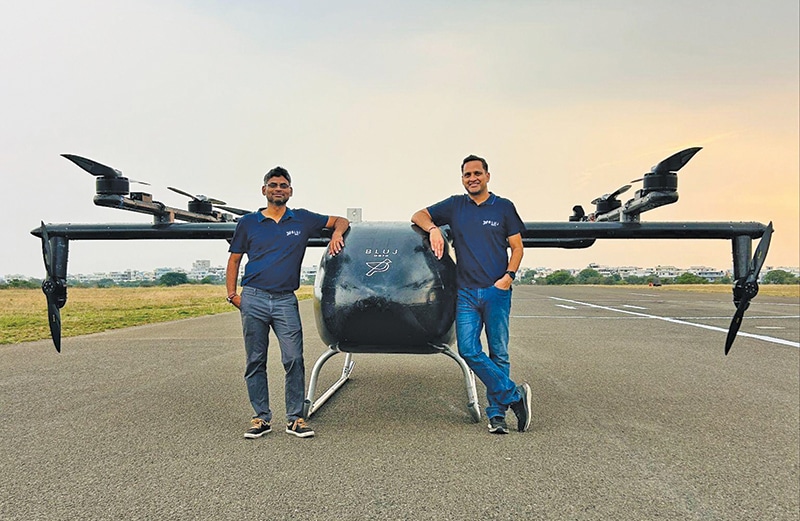
The startup says it develops most of its critical aircraft systems in-house, including the airframe structure, battery packs, electric motors, inverters, and propulsion architecture. According to BluJ Aerospace’s Vice President of Product, Pranay Rebala, around 75% of the aircraft’s component cost is currently localised through in-house manufacturing. Certain raw materials, including battery cells and rare earth magnets, are still sourced internationally because of limited domestic availability.
BluJ’s manufacturing facility is in Adibatla, Hyderabad. Spread over 25,000-30,000 square feet (2325-2790 sq. metres), the facility is designed for low-volume production, supporting about 15-20 aircraft annually.
Pranay shares that most manufacturing, system integration, and testing are carried out internally, while specialised environmental and structural tests are conducted through external laboratories.

The startup’s current commercial products are the BluJ Reach series, comprising the Reach M, a shorter-range multicopter platform, and the Reach L, a longer-range fixed-wing VTOL aircraft. Rather than selling standard off-the-shelf aircraft, BluJ customises the platforms to customer requirements.
At present, BluJ is not focusing on outright aircraft sales. Explaining the approach, Pranay says, “We are focusing on lease-based and service-based business models.” Under this approach, the company may lease aircraft or operate cargo transport missions on behalf of customers, charging based on cargo weight, distance, or mission profile. “This strategy lowers the adoption barrier for customers who are unfamiliar with VTOL operations while enabling BluJ to gain operational experience before expanding aircraft sales,” he adds.
The startup remains in a pre-revenue stage for its core aircraft business. It has conducted demonstration flights and is in discussions with potential customers, while generating limited revenue through strategic subsystem and component sales for applications outside its primary business.
“BluJ views the market as one that needs to be developed rather than one with established demand, as it is attempting both to replace certain helicopter missions and to create new logistics opportunities in regions that are currently underserved,” adds Pranay.
BluJ is pursuing both battery-electric and hydrogen-electric propulsion. Its first commercial products will be battery-powered aircraft intended for shorter-range operations. In parallel, the startup is developing hydrogen fuel-cell systems for future long-range VTOL platforms targeting a range of approximately 250km. “The hydrogen architecture follows a parallel hybrid configuration in which both the battery and fuel cell supply power during take-off and landing, while the fuel cell alone powers cruise flight. This is intended to combine the high power required for vertical lift-off with the higher energy density and endurance benefits of hydrogen during forward flight,” explains Pranay.
The startup has already built and ground-tested a hydrogen fuel-cell powerplant and high-pressure carbon-fibre hydrogen tanks.
BluJ currently employs about 50 full-time staff and is working closely with regulators on approvals for beyond-visual-line-of-sight and long-range cargo operations. “Regulatory engagement is particularly important because commercial VTOL operations require approvals covering airworthiness, operational procedures, remote operations, and safety management,” says Pranay.
The startup’s immediate plans include establishing an operational base for cargo services, expanding the Reach product line, and advancing its 250km hydrogen-electric aircraft programme. It also intends to establish a larger dedicated production facility as manufacturing volumes increase. In the longer term, once its cargo operations have gained sufficient maturity and public confidence, BluJ plans to enter the passenger mobility market.
Explaining the startup’s name, Pranay says ‘BluJ’ is inspired by the Blue Jay bird associated with Telangana, reflecting the founders’ local roots and the company’s origin in the state.
