





A blue pigment-derived catalyst has delivered 902 mW/cm² in an anion-exchange membrane fuel cell, showing how molecularly engineered iron catalysts could reduce reliance on platinum.
Researchers in Japan and Israel have developed a platinum-free fuel-cell catalyst based on blue pigment chemistry that delivered 902 milliwatts per square centimetre (mW/cm²) in an anion-exchange membrane fuel cell (AEMFC). The result came from an iron tetra-azaphthalocyanine catalyst developed by researchers from Tohoku University, Technion, Hokkaido University and AZUL Energy.
The work targets the oxygen reduction reaction at the fuel-cell cathode, where platinum is commonly used to accelerate the reaction. Instead of platinum, the researchers used iron-containing molecules derived from phthalocyanine chemistry and modified their molecular structure to improve oxygen-related reactions.
Fuel cells generate electricity by combining hydrogen and oxygen, with water as the main reaction product. In an AEMFC, the alkaline environment makes it possible to investigate catalysts that do not rely on platinum-group metals. The researchers focused on metal phthalocyanines, a class of compounds associated with intensely coloured pigments.
The team developed two catalysts. AZ-FT-30 uses an iron tetra-azaphthalocyanine containing four additional nitrogen atoms, while AZ-FO-30 contains a more nitrogen-rich molecular structure. Both were supported on conductive Ketjen Black carbon.
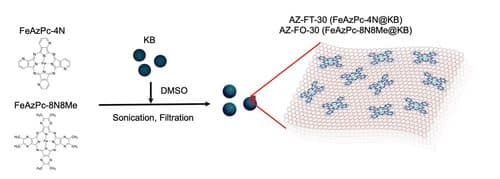
The difference in molecular structure produced a measurable change in fuel-cell performance. Tested at 80°C, AZ-FT-30 achieved a peak power density of 744 mW/cm², while AZ-FO-30 reached 902 mW/cm². The researchers report the latter as the highest power density reported for an AEMFC cathode based on a metal phthalocyanine.
The researchers used density functional theory calculations to investigate why AZ-FO-30 performed better. The calculations showed that the modified molecule produced a shorter iron–oxygen distance for adsorbed hydroxyl, indicating stronger interaction at the iron active site. This trend corresponded with the experimental performance of the catalysts.
Performance was not the only test. The AZ-FO-30 cell operated for 35 hours at a constant current density of 400 mA/cm², with an average voltage decay of 2.4 mV/h. However, this remains a short laboratory demonstration compared with the durability expected from transportation fuel cells. The US Department of Energy, for example, has used 5,000 hours as an automotive fuel-cell durability target.
The research is not yet a replacement for platinum fuel-cell stacks. The experiment was conducted in an AEMFC test cell, and the 35-hour durability result leaves substantial room for longer-term testing. The paper itself describes the result as a basis for further optimisation of the catalyst and electrode architecture.
AZUL Energy is already developing the underlying catalyst commercially. The company lists its AZUL Catalyst as a rare-metal-free catalyst for fuel cells and other electrochemical applications. In July 2026, it began selling the catalyst as a research reagent through Fujifilm Wako Pure Chemical, expanding access beyond its earlier collaborative and custom-supply model.
The research also has relevance to India’s hydrogen plans. The National Green Hydrogen Mission has an initial outlay of ₹19,744 crore and targets 5 million tonnes of annual green hydrogen production capacity by 2030. India is also already deploying hydrogen fuel-cell technology: NTPC handed over five hydrogen fuel-cell buses to the Leh administration in June 2025 as part of its green hydrogen mobility project.
For hydrogen fuel cells, replacing platinum is not simply a question of finding a cheaper catalyst. It also requires comparable power output, durability and scalable manufacturing. The new pigment-derived catalyst addresses the first of these at laboratory scale, while its long-term durability and system-level performance remain to be demonstrated.
For more information, click here.

