




Embedded storage devices combine flash memory and controller functions for consumer, industrial, networking, and other electronic products.
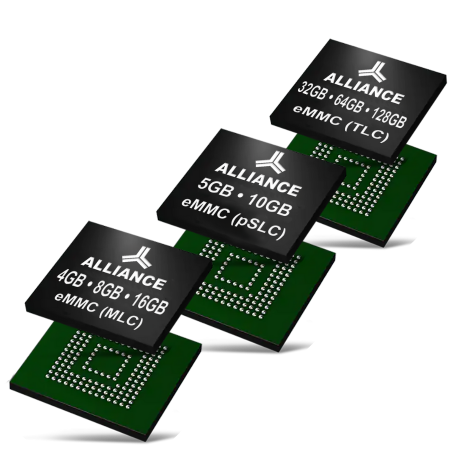
Alliance Memory has expanded its industrial-grade embedded multimedia card (eMMC) storage portfolio with devices ranging from 20GB to 512GB. The eMMCs combine TLC NAND flash memory, an eMMC controller, and flash transition layer (FTL) management software in a single package for embedded storage applications.
The eMMCs comply with the JEDEC eMMC v5.1 standard and support functions including boot operation, replay-protected memory block (RPMB), device health reporting, field firmware updates, power-off notification, enhanced strobe, write levelling, high-priority interrupt (HPI), and secure trim and erase. They also support HS200 and HS400 modes for high-speed data transfer and are backwards-compatible with eMMC v4.5 and v5.0.
The devices are intended for embedded storage in products such as smartwatches, tablets, mobile handsets, navigation systems, multifunction printers, digital TVs, set-top boxes, virtual reality and augmented reality headsets, and digital cameras. They can also be used in CCTV, infotainment, surveillance, home and factory automation, point-of-sale systems, and other embedded applications.
For system designers, integrating the controller and FTL software with the NAND flash in the same package removes the need for a separate external eMMC controller. This reduces the number of components required on the board and frees up PCB space.
The integrated FTL software manages functions such as wear levelling and bad-block management. These functions help distribute write operations across the NAND flash and manage blocks that are no longer suitable for data storage, supporting consistent operation over the device’s usable life.
“Our expanded eMMC portfolio is designed to provide easy and fast system integration for embedded NAND flash applications across densities ranging from 4GB to 512GB,” said David Bagby, president and CEO of Alliance Memory. “With the addition of our new 20GB, 64GB, 128GB, 256GB, and 512GB devices, customers can support larger data sets and increasing storage requirements while benefiting from simplified integration, robust reliability, and cost-effective performance for consumer, industrial, and networking applications. And as with all our memory solutions, we will provide long-term support for these devices, giving our customers the confidence to design them into products with extended lifecycles.”

