




A new soft robotic gripper combines flexible fingers and rotational motion to manipulate objects without releasing them, opening possibilities for electronics assembly, logistics, and collaborative robotics.
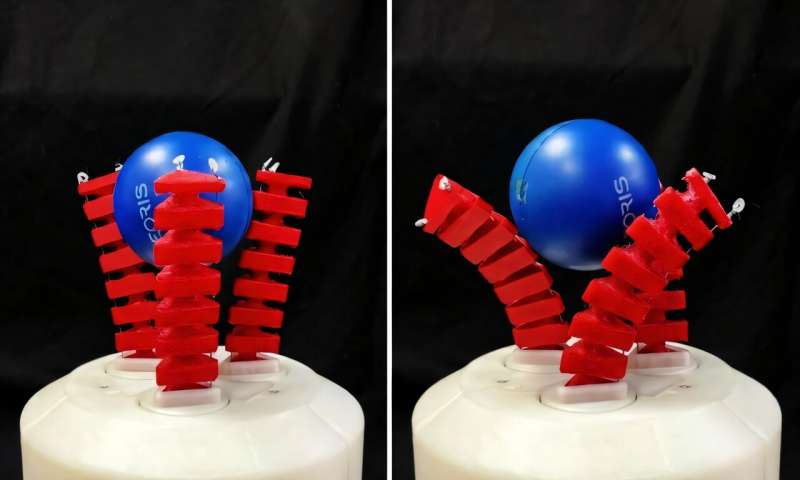
Researchers from Universidad Carlos III de Madrid (UC3M) and Universidad Pública de Navarra (UPNA) have developed a modular soft robotic gripper that can pick up, reposition, and reorient objects while maintaining its grip. Unlike conventional soft grippers that primarily focus on grasping, the system enables in-hand manipulation, allowing a robot to adjust an object’s position without putting it down.
The gripper uses three flexible fingers, with each finger providing three degrees of freedom. In addition to bending, the fingers can rotate around their bases. Coordinating these movements allows an object to roll between the fingers and change orientation while remaining securely held. This gives the gripper a capability closer to the continuous adjustment performed by a human hand when turning an object.
This approach addresses an important limitation in robotic manipulation. Rigid industrial robots can deliver high positioning precision but generally work best when the geometry and location of an object are known in advance. Soft robotics instead uses compliant structures that can adapt their contact with objects, making the technology better suited to irregular, delicate, or variable shapes.
- Three soft fingers with three degrees of freedom each
- Finger bending combined with base rotation
- In-hand object rolling and reorientation
- Replaceable modular finger architecture
- Designed for fragile and irregular objects
The researchers tested the gripper with a variety of objects, including bottles, cubes, tissue packs, toys, a 3D-printed figurine, a rubber duck, a screwdriver, and an artificial rose. The tests demonstrated that the gripper could maintain its grasp while changing how objects were positioned.
A modular mechanical architecture is another notable feature. The three fingers can be assembled and removed independently, allowing an individual finger to be replaced instead of requiring replacement of the complete gripper. This could simplify maintenance in industrial robotic systems.For electronics manufacturing, the technology could be useful wherever components need to be picked, rotated, and accurately oriented before assembly. Similar capabilities could support automated handling of irregular parts, inspection processes, laboratory automation, and flexible production lines.The researchers also point to applications in food processing, logistics, laboratory environments, and collaborative robotics, where machines need to manipulate objects while adapting to changing surroundings and operating safely around people.
