

A new processor IP core combines state-space model architecture with low-power computing to run generative AI locally, enabling responsive, privacy-focused intelligence across embedded and connected devices.
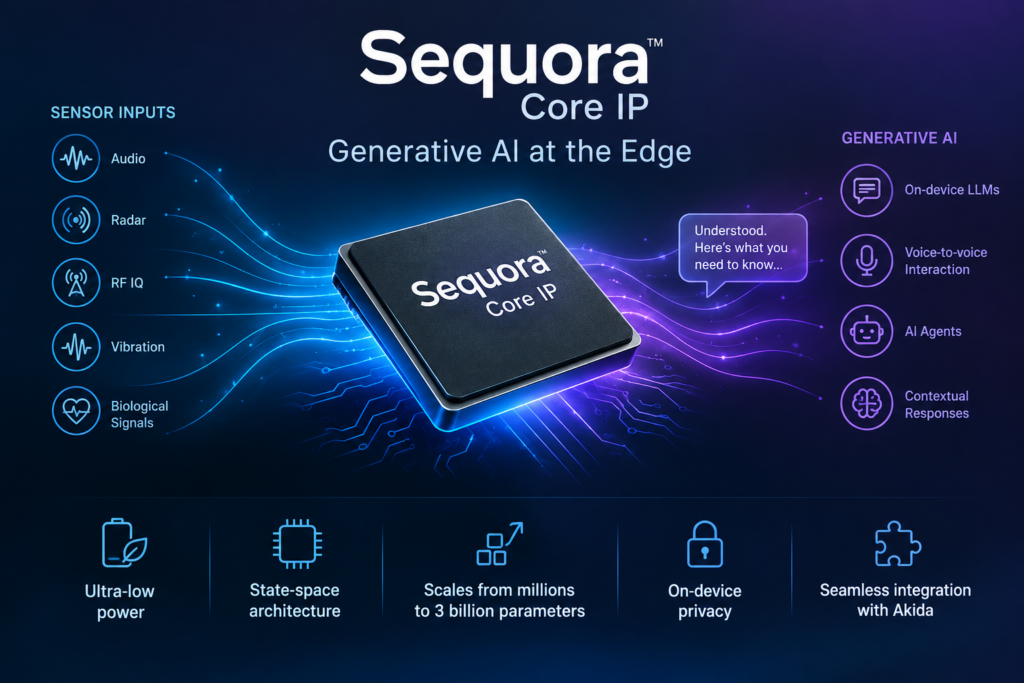
BrainChip’s Sequora Core IP is a licensable processor intellectual property (IP) designed to run generative artificial intelligence (AI), including large language models (LLMs), directly on battery-powered edge devices. It supports models ranging from a few million parameters to 3 billion, targeting applications where memory capacity, power consumption and response time limit conventional generative AI deployments.
The core uses a state-space model architecture that maintains fixed memory requirements regardless of the length of an incoming data stream or conversation. This approach addresses a key limitation of conventional generative models, in which growing conversation context and associated cache requirements can increase memory usage and processing overhead. By limiting memory growth, Sequora aims to make on-device language processing practical within constrained power budgets.
The key features are:
- Supports generative AI models up to 3 billion parameters.
- Uses a state-space architecture for fixed memory requirements.
- Supports on-device LLMs, voice interaction, and AI agents.
- Combines with Akida for sensor and generative AI workloads.
- Includes a static graph compiler, C++ runtime, and model zoo.
Sequora can operate alongside BrainChip’s Akida neuromorphic AI platform, combining sensor processing with generative inference. Akida processes streaming inputs such as vibration, audio, radar, raw radio-frequency (RF) in-phase and quadrature (IQ) data, and biological signals. Sequora handles sequential AI workloads, including on-device LLMs, voice-to-voice interaction and AI agents. Together, the two technologies enable devices to interpret sensor inputs and generate contextual responses without relying on continuous cloud connectivity.
Potential applications include voice-enabled wearables and earbuds, industrial Internet of Things (IIoT) equipment, automotive systems, industrial radar, medical and biomedical devices, and aerospace and defence electronics. Local processing can reduce dependence on network connectivity, improve response times and help keep sensitive data on the device. The architecture also targets predictable runtime behaviour for safety-critical applications, including automotive, medical and avionics systems.
Sequora is available as licensable semiconductor IP for integration into customer-designed system-on-chips (SoCs). The design is supplied as process-portable, synthesizable register-transfer-level (RTL) code, allowing implementation at the foundry and process node selected by the customer.
The development package includes verification IP, a testbench, synthesis scripts, timing constraints and a software development kit (SDK). The SDK provides a static graph compiler, a C++ runtime library and a model zoo to support integration and model deployment.
Click here for the original announcement.