

The development board combines dual Arm Cortex-M33 and RISC-V cores, onboard flash, and USB connectivity for compact embedded applications.
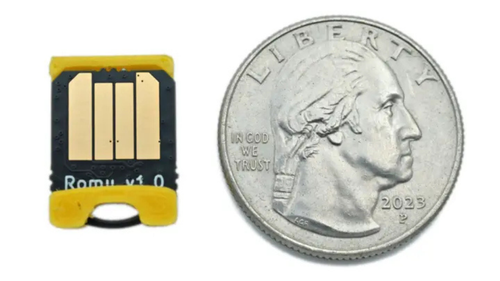
Bitmerse has introduced Romu, a compact USB development board based on the Raspberry Pi RP2354A microcontroller. Measuring just 15.5 × 12 mm, the board plugs directly into a USB Type-A port without requiring cables, a breadboard or additional adapters. It is designed for USB-based applications such as security keys, MIDI controllers, macro pads and custom human interface devices (HIDs).
The RP2354A integrates dual-core Arm Cortex-M33 processors running at up to 150 MHz, with Arm TrustZone security and secure boot support. It also includes dual 32-bit RISC-V Hazard3 cores operating at up to 150 MHz. Users can run up to two cores simultaneously, choosing between the Arm and RISC-V architectures or combining one core from each. The chip includes 520 KB of SRAM and 2 MB of flash memory stacked within the package.
The board provides a native USB 2.0 Full-Speed interface and receives its 5 V supply directly from the host, with onboard regulation supplying 3.3 V to the circuitry. Its compact PCB includes a capacitive touch button, a boot button for firmware flashing and an RGB LED for status indication. Programming and debugging are supported through USB Device Firmware Upgrade (DFU) and Serial Wire Debug (SWD) test points, while separate UART transmit and receive pads provide serial access. The board does not expose conventional GPIO pins, making it primarily suitable for applications that communicate through USB rather than direct peripheral connections.
Romu comes preloaded with MicroPython, allowing developers to begin programming through the Thonny IDE or another compatible development environment. An optional programming and debugging jig connects through USB Type-C and provides a standard 20-pin JTAG connector for SWD debugging, along with UART access. Example projects include a FIDO2 security key, a simple game and a website launcher, demonstrating how the board can be configured for different USB functions.
The hardware design is intended to be released with schematics, PCB design files, a bill of materials and 3D enclosure files through GitHub. Bitmerse has launched Romu through Crowd Supply, with pricing starting at US$40 for the board and an additional US$65 for the programming and debugging jig. Shipping is expected to begin by the end of April 2027.
For more information, click here.