Smoke alarms can’t tell burning wire from incense, but this thermal-imaging switch sees heat itself and cuts power automatically. Within just ‘6 hours’, you can build this ‘medium’ complexity device for under ₹4400!
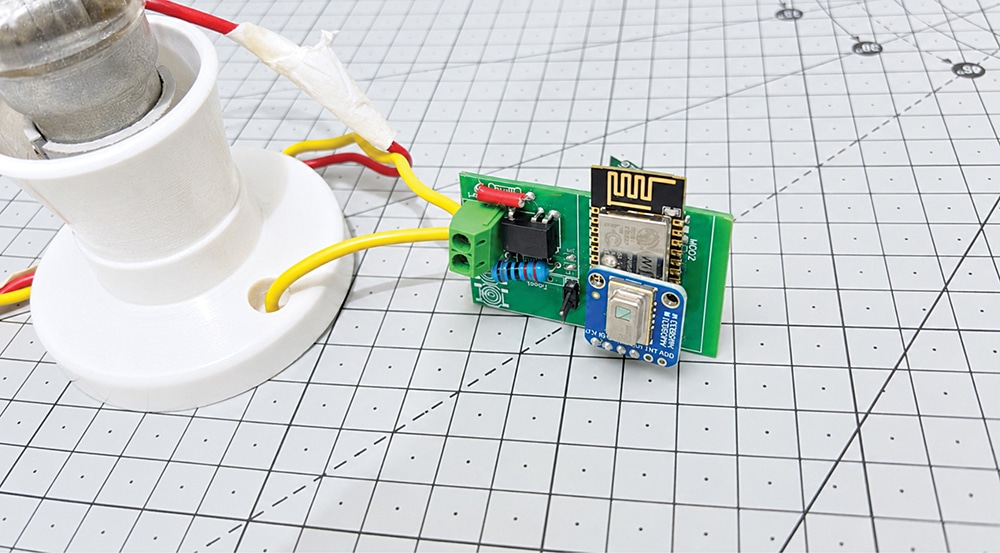
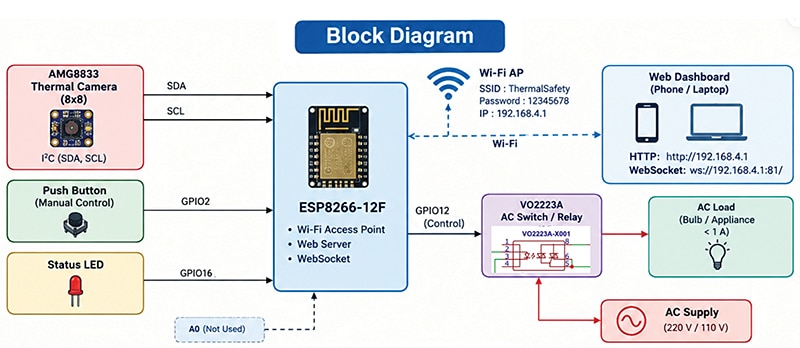
Smoke alarms can’t tell burning wire from incense. This thermal-imaging smart switch sees heat itself, so cooking fumes and incense won’t fool it. Built around the ESP8266-12F Wi-Fi module and an AMG8833 thermal grid sensor, it watches for overheating wires, potential short circuits, excessive current-related heating in power lines, elevated boiler surface temperatures, and hot SMPS units or PCBs within the sensor’s 0-80°C measuring range. When the measured temperature exceeds a preset threshold, it automatically switches off the connected AC load. It also supports manual control and IoT-based operation through a wireless web dashboard, which streams live thermal images and temperature readings and lets you configure the threshold. An opto-TRIAC (VO2223A) switches AC bulbs and appliances with loads below 1A. Properly calibrated, the switch makes overheating detection more reliable. Fig. 1 shows the author’s prototype, while Fig. 2 depicts the block diagram of the system.
| Bill of Materials | ||||
| Reference | Component | Value/Type | Quantity | Cost (₹) |
| MOD2 | ESP-12F Wi-Fi module | – | 1 | 149 |
| MOD1 | Thermal sensor | AMG8833 | 1 | 3899 |
| IC1 | Opto-TRIAC | VO2223A-X001 | 1 | 225 |
| IC2 | Voltage regulator | AMS1117-3.3, 3.3V 1A | 1 | 5 |
| R1 | Resistor | 120Ω, 1/4 W, 5% carbon film | 1 | Miscellaneous ~122 |
| C1 | Ceramic capacitor | 22µF | 1 | |
| C2 | Ceramic capacitor | 10µF | 1 | |
| SW1 | Tactile switch | TSC005A2518A | 1 | |
| CONN1 | 2-pin connector | – | 1 | |
| CONN2 | Screw terminal | – | 1 | |
| – | PCB | – | 1 | |
| Estimated total | 4328 | |||
What will you learn?
By building this project, readers will learn how to capture thermal images using an I²C-based Grid-EYE sensor, implement digital input/output control for load switching, establish Wi-Fi connectivity, and develop a real-time web application using WebSockets. The project also demonstrates power regulation, opto-isolated AC load control, and the integration of thermal sensing, processing, switching, and remote monitoring into a compact system.
Parts list and cost
The design is built around the ESP-12F Wi-Fi module and the VO2223A-X001 opto-TRIAC for isolated AC load control. The components, their designators, and estimated prices are listed in the Bill of Materials table.
How it works
The project uses the AMG8833 Grid-EYE thermal imaging sensor to generate a real-time thermal image of the monitored area. The system detects elevated temperatures associated with potential hazards, such as overheating wires, short circuits, overloaded power lines, and boiler overheating, while also monitoring ambient temperature. When the measured temperature exceeds a preset threshold, the ESP-12F module triggers the VO2223A-X001 opto-TRIAC to switch off the connected AC load. The VO2223A-X001 integrates an optocoupler and a TRIAC in a single package, providing electrical isolation between the low-voltage control circuit and the AC switching circuit. For loads above the opto-TRIAC’s current rating, use an external, suitably rated TRIAC, relay, or solid-state relay (SSR). The system transmits temperature data and the live thermal image over Wi-Fi to a web dashboard, allowing users to monitor temperature variations, configure temperature thresholds and control the connected load manually. Once the temperature falls below a set recovery temperature, the load can be switched on again.
Circuit and working