




A Raspberry Pi Pico W-powered automatic cat feeder uses weight and ultrasonic sensors to monitor food levels and track how much a pet actually eats.
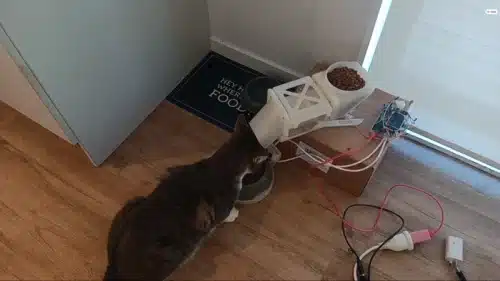
Pet feeders are quite popular devices for hardware vendors, although many of them use just timers to release food portions. The feeding is done for a predetermined amount of time; a motor or an auger will operate without checking the level of the bowl or the amount of food the pet has consumed. The project uses a completely different way of making a feeder smart and they use a weighing device and ultrasonic sensors along with Raspberry Pi Pico W.

The project incorporates the Raspberry Pi Pico W for controlling the motor, sensing the data and facilitating wireless communications. The weight sensor positioned under the feed tray senses the weight of the food. This is in place of the earlier technique of measuring the time of the motor operation and estimating the quantity of the portion. It can also sense the changing weight of the food in the feed tray.
Ultrasonic sensing is also employed to sense the proximity of the pet as the pet gets close to the bowl. The system is able to know whether there has been consumption of the food or not based on the weight before and after the process. This information is more meaningful than that provided by the time-based system. The information also helps in knowing when there has not been consumption of the food or when there is malfunction of the dispenser.
The Pico W is equipped with Wi-Fi capabilities and makes use of them to send information regarding feedings to a local server. It thus helps owners keep track of their pets’ feedings remotely and log food intake. In the right implementation of the software, it will also alert the owner when the pet skips meals and keep track of the food intake every day.
The project shows how inexpensive microcontrollers and basic sensors can add feedback and monitoring to everyday appliances. For makers and pet-tech developers, the same approach could be adapted to build feeders with portion control and consumption tracking. However, accurate food measurements will depend on sensor calibration and the system’s ability to distinguish actual eating from food being moved or removed. By replacing fixed-time dispensing with sensor-based control, the design demonstrates a practical use of embedded systems in home automation.