Multiferroic materials could enable memory and logic devices that consume less power. A fabrication technique addresses a major obstacle to integrating them into chips.
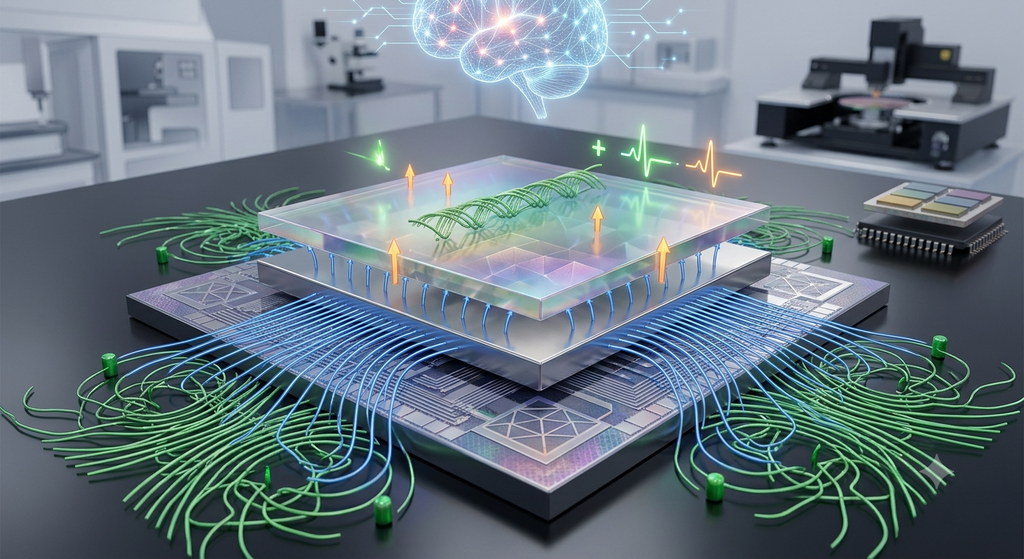
Researchers at Brown University have developed a technique to fabricate ultra-thin films of bismuth ferrite that retain their electrical and magnetic properties. The development could help bring multiferroic materials closer to use in low-power memory and logic devices, including those intended for AI computing.

Multiferroics have combined electric and magnetic properties. This means they can be manipulated using relatively low voltages. The electric polarisation can be flipped between two states to represent binary data storage; however, the magnetic properties can be used to read the information due to their dependence on each other. This could be used to store and process information with low-power voltage pulses.
However, these materials have proven problematic to make ultra-thin for integration into semiconductor chips. At very low thicknesses, the structure and chemistry of the material change. This can cause the electric fields within the material to dominate over the electric polarisation. This is called the dead-layer effect, which causes the material to lose its ferroelectric and magnetic properties.
This problem was overcome by using a dysprosium scandate substrate. This induces compressive strain in the film due to the difference in crystal structure. This helps keep the useful atomic structure in the film. The material was also placed on a second metal layer to absorb any stray electric fields. This helps keep the electric polarisation present at very low thicknesses.
The films produced retained their multiferroic properties. This resulted in the material having improved magnetic properties. They also discovered that the layered structure induced altermagnetism in the bismuth ferrite.
These altermagnets can offer faster operation and reduced stray magnetic fields while retaining signals that can be detected for readout. This could help address limitations associated with densely integrating conventional magnetic devices.