

Two rapidly rotating LED panels create a volumetric image inside a globe, with a Raspberry Pi 4 controlling the display and synchronising its images with the rotation.
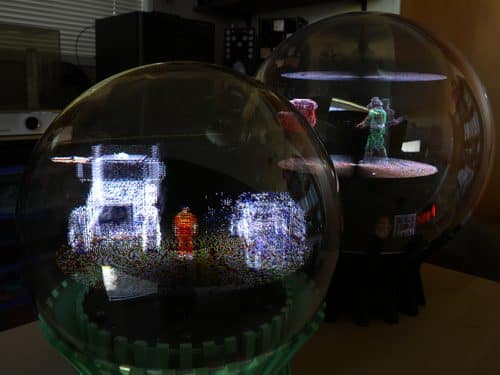
A maker known as AncientJames has built a volumetric display that creates a three-dimensional image using two spinning LED panels. The project, called Vortex, uses a Raspberry Pi 4 to control the panels and generate images that appear to float inside a globe. The hardware design and software are available online, allowing other makers to study and reproduce the build. The display uses two 128 × 64-pixel HUB75 LED panels mounted back to back. They rotate around a vertical axis at several hundred revolutions per minute inside a casing built around a 300mm truncated spherical globe.

The LED panels consist of a series of light grids. As the panel turns, the illuminated points create an illusion of a three-dimensional space. This works in the same way that a moving sparkler will give you the illusion of a circle being drawn. Vortex employs two LED panels to create an illusion of a three-dimensional image that can be seen from any angle. Its signal changes between high and low states during each half-turn, giving the software a reference point for updating the image.
The software uses a shared-memory voxel buffer to store the three-dimensional image data. A display driver reads this data and sends it to the LED panels in synchronisation with their physical rotation. Separate programs generate and update the content. The system also includes an OpenGL-based simulator that displays the same voxel data in a window, allowing developers to test images without running the physical hardware. The software supports different bit depths from one to three bits per channel. Higher bit depths reduce the refresh rate. When the rotation speed exceeds what the display can refresh, some voxels may be skipped and can cause gaps or trails in the displayed image. The software includes a trial adjustment to compensate for skipped voxels.
The main hardware includes two P1.875 HUB75 LED panels, two 6mm × 225mm carbon-fibre rods, a Raspberry Pi 4, a HUB75 interface board and a photointerrupter. The mechanical assembly uses 6015 and 6804 bearings, a car alternator slip ring identified by parts ASL9013 and ABH6004S, a YM2776 motor and a Mean Well LRS-100-12 power supply. It also requires a drive belt, M4 fasteners and lead sinkers for counterweights. The casing is made from 3D-printed components and a post-top lamp globe cut to size. An optional control dial can use a Raspberry Pi Pico W, accelerometer, rotary encoder, another photointerrupter and a 1.28-inch round touch display. A simpler alternative uses a motor speed controller and a knob.
To assemble the display, makers can start by printing the frame, core and casing components from the VortexParts repository. The two carbon-fibre rods fit into channels in the printed core, but these channels must first be cleared using a 6mm drill. The LED panels are then mounted back to back and secured to the rods. The Raspberry Pi, HUB75 interface and photointerrupter fit inside the core. The bearings, slip ring, motor and drive belt form the rotating assembly, while counterweights help balance it. Balancing is a particularly demanding part of the build, and the rotating assembly should be tested carefully with suitable eye protection.
The Multivox software and demonstration programs are available on GitHub under the MIT licence. The repository includes demos such as multiplayer light cycles, fireworks, a science-fiction-style flight simulation, a rotating four-dimensional cube and a viewer for 3D models and images. A Python-based tool can also stream point-cloud data from a computer to the display over Wi-Fi. The repository provides build commands for compiling the software on a Raspberry Pi 4. The separate VortexParts repository provides a STEP file containing the printable mechanical components, although it does not specify an explicit licence for these hardware design files.
For more information, click here.