




It can help in accurately detecting and creating images of even weak magnetic particles present in a tumour or blood vessel
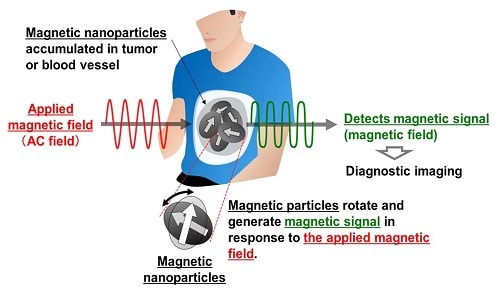

Magnetic resonance imaging (MRI) diagnostics and X-ray computerised tomography (CT) scanning are used in clinical services to diagnose organ health, tumours and other health conditions with the help of contrasting density of imaged objects. On the other hand, magnetic particle imaging detects the magnetic signals generated by the accumulated tumour or blood vessel, thereby recognising only injected materials (which can be radioactive isotopes or magnetic particles) to create images similar to positron-emission tomography (PET). When intended for medical imaging, such imaging devices need to be highly sensitive to detect even tiny amounts of magnetic particles.
Now, Yokohama National University (YNU) in collaboration with TDK Corporation has developed a prototype image diagnosis technology that utilises a high-sensitivity magnetic sensor, which can accurately detect and create images of magnetic particles present in a tumour or blood vessel.
Conventional magnetic particle imaging technologies primarily measure electromotive force induced through detection coils. The new technology employs a high-sensitivity magnetic sensor to achieve this and detect weak magnetic fields at room temperature. Even though still under development, the prototype sensor has shown promising results in measuring magnetic field distribution in a heart, thus strengthening its feasibility for use across the head or the entire human body.
At the same time, the sensor reduces the strength of the alternate current magnetic fields (that are applied from outside the body) to one-tenth. This reduction is achieved by the non-linear response characteristics of the sensor to the measured magnetic field strength.
With the goal of creating magnetic particle imaging devices for more medical services, YNU and TDK will continue to develop this technology in the future.


