


Breakthrough research headed by City College of New York physicist Lia Krusin-Elbaum could pave the way for new quantum device platforms!
A team of physicists and chemists has developed a new method for reducing charge carrier density in the bulk of three-dimensional (3D) topological insulators and magnets using ionic hydrogen. As a result, it is possible to manipulate and regulate non-dissipative surface or edge quantum conduction channels.

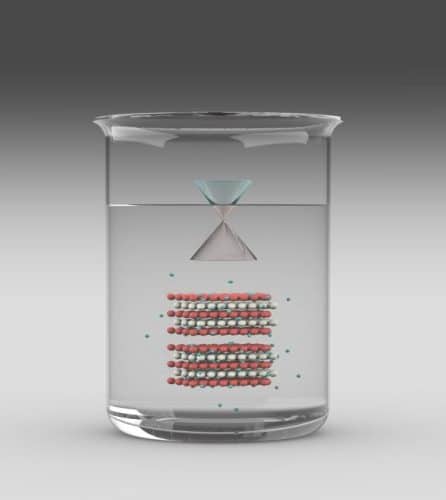
The insertion and extraction of ionic hydrogen from dilute aqueous hydrochloric acid (HCl) solution is used to tune chalcogen-based topological materials and nanostructures in a laboratory chamber, which leaves the layered topological crystal structure as well as electronic bands intact and has the added benefit of removing native surface oxide while passivating surfaces.
Electrons are donated by a reversible binding of H+ ions to chalcogens, such as Te or Se, and bulk carrier densities are reduced by orders of magnitude to achieve access to robust topological surface states without affecting carrier mobility or the band structure in this process, which the team tested in the Krusin Lab for two-dimensional electrical transport.
“The main advance of this work is that the new hydrogenation process is fully reversible, as hydrogen-chalcogen moiety can be disassociated by a low-temperature annealing protocol under which hydrogen is easily removed,” said Krusin-Elbaum, professor in CCNY’s Division of Science. “It is also multiply-cyclable and reproducible, thereby resolving one of the key limitations of magnetic and nonmagnetic topological insulators and can be applied not only post-growth to materials but also to fully fabricated nanodevices.”
The Krusin Lab’s research focuses on novel quantum phenomena like the Quantum Anomalous Hall (QAH) effect, which describes an insulator that conducts dissipation-less current in discrete channels on its surfaces, 2D superconductivity, and axion state phenomena with quantized thermal transport, all of which have the potential to advance energy-efficient technologies if industrialised. According to Krusin-Elbaum and her colleagues, the technique they presented is quite broad and could help to enhance the potential of intrinsic topological magnets in quantum electronics in the future.
Read the entire study here.