

Researchers have developed a comfortable and durable self-powered fabric that can be connected with sensors to help adjust posture in real time.
The importance of posture in one’s health cannot be overstated. Slouching or leaning to one side for an extended period of time can cause pain and discomfort. It’s also been linked to an increased risk of heart disease, visual issues, strokes, and musculoskeletal ailments.

Triboelectric nanogenerators (TENGs) were used to create the self-powered fabric, which absorb energy from movement to power the posture monitoring sensors. The data acquired by the sensors is analysed by an integrated machine learning algorithm that may provide rapid feedback and inform the wearer when their posture needs to be adjusted.
“People often sit in various poor postures in their daily life, leading to pain and discomfort,” said paper author Kai Dong, an associate researcher at the Beijing Institute of Nanoenergy and Nanosystems at the Chinese Academy of Sciences. “This ‘sitting disease’ could be alleviated if individuals were able to observe their real-time sitting posture by wearing a specific type of clothing made with smart textiles. With the self-powered sitting position monitoring vest we developed, users can watch their posture change on their screen and make necessary adjustments.”
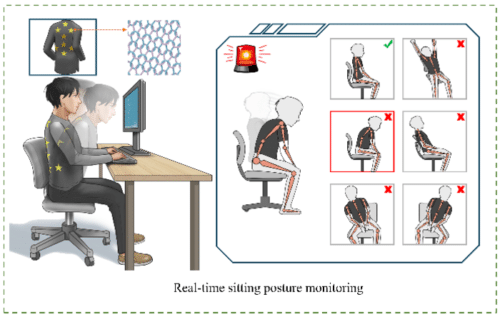
A nylon fibre is knitted together with a conductive fibre to make the unique fabric. The fibres of the cloth are stretched and compressed as the wearer moves. Contact electrification is the result of the constant movement and contact between the two fibres, which produces electricity.
The fabric is stretchy, resilient, washable, and breathable, and it may be worn for long periods of time without discomfort. As a result, it’s suitable for long-term posture tracking. Aside from the fabric’s comfort, the dependability of the posture tracking system is also significant. In points along the cervical spine, thoracic spine, and lumbar spine, the sensors are stitched directly into the cloth. These positions aid in the collection of data on the most common slouching postures, such as the humpback posture.
The information gathered by the sensors is then processed by a machine learning algorithm, which classifies the wearer’s sitting position and analyses how they modify their posture when encouraged. 96.6 percent of the time, this system correctly recognises the wearer’s posture.
Click here to access their study.