





Tissue engineering, or the science of generating human cells for use in medicine, is still in its infancy. However, researchers claim that a new tissue engineering process involving growing cells on a moving robot skeleton could potentially increase the quality of this work.
Researchers from the University of Oxford and Devanthro Robotics believe that if you want to develop matter that moves and flexes like tendons or muscles, you should try to mimic their natural growing environment as closely as possible. As a result, they chose to model a mobile human body.

Because growing cells in a real person is difficult, the multidisciplinary team opted to use a robot to simulate the human musculoskeletal system as closely as possible. They modified a Devanthro engineer’s open-source robot skeleton and constructed a bespoke growing environment for the cells that can be inserted into the skeleton to bend and flex as needed. (These kind of growing environments are referred to as bioreactors.)
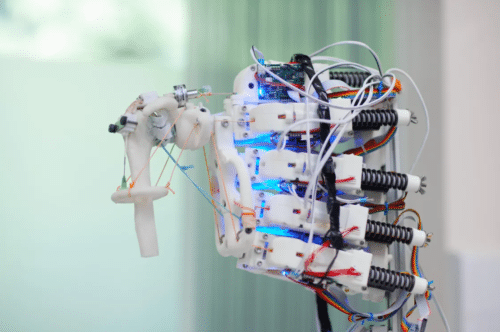
The robot’s shoulder joint, which had to be updated to more exactly imitate our own movements, was chosen as the site for tissue agriculture. They then built a bioreactor that could be inserted into the robot’s shoulder, made up of strings of biodegradable filaments stretched between two anchor points like a hank of hair, with the entire structure wrapped within a balloon-like outer membrane.
The robot’s shoulder joint, which had to be updated to more exactly imitate our own movements, was chosen as the site for tissue agriculture. They then built a bioreactor that could be inserted into the robot’s shoulder, made up of strings of biodegradable filaments stretched between two anchor points like a hank of hair, with the entire structure wrapped within a balloon-like outer membrane.
The human cells were then seeded into the hair-like filaments, and the chamber was inundated with a nutrient-rich liquid to promote growth. While the team noticed differences in exercising cells compared to those grown in a static environment, they aren’t sure if those differences were beneficial. “We need to do much more work to understand what’s really going on,” says the lead researcher on the project, Pierre-Alexis Mouthuy of the University of Oxford’s Botnar Institute of Musculoskeletal Sciences.
Read the entire study here.
