

What happens when wind power plants face blackouts? How is the recovery done? How do engineers build a wind farm with hundreds of different power generators that work together to restore power to homes and businesses?
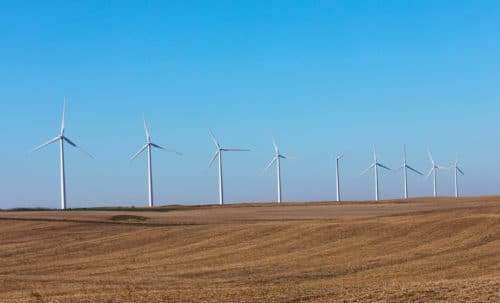
Villegas Pico and Vahan Gevorgian, a chief engineer at the National Renewable Energy Laboratory at Iowa State University, describe the development of grid-forming controllers and a stall-prevention subsystem that allows certain wind turbines to blackstart a power grid in a research paper published online. “If wind power plants are not able to restore a power system, the incorporation of wind resources into electric grids could be limited by blackstart capability,” the researchers wrote in their paper.
The first challenge for “Type 4” turbines, which have fully rated electronics converters to transfer all of their generating capacity to the grid, according to Villegas Pico, was developing a grid-forming control strategy that would allow turbines to operate on the grid independently of any gas or hydro turbines, which is currently not possible. “The control strategy is a software algorithm,” Villegas Pico said. “It steers the operation of wind turbines so they’re capable of reliably restoring power systems.”
The second issue was to create an active protection system that would prevent wind turbines from stalling (or stopping) during the recovery from a blackout if power demand exceeded available wind. The researchers demonstrated that their new control methods can reenergize a wind-dominated power grid, ride through asymmetrical faults, and withstand low-speed winds by inserting their ideas into a computer model. Artificial intelligence and weather forecasting technologies are also being developed as part of the initiative to assist operators in orchestrating the restoration of wind-dominant grids.
“Our contributions are significant to satisfy restoration, reliability, and interoperability standards,” the researchers wrote. “They are also important to not: jeopardize restoration processes, cause economical losses, and endanger lives, for example, if electricity is critical for heating in cold weather.”

Click here to access their paper.