

Yes, AI is spreading like a forest fire through the job market. Tens of thousands of engineers across India lost their jobs to AI-driven restructuring last year and continue to do so this year. It is not about the economy, policy, or the numbers. It is about you, the one affected by it right now, wondering what the way forward is.
If you are a recent graduate, you might be worried about getting a job. If you already have one, you might be worried about losing it. This is especially true in the technology industry, particularly in software and other fields where AI can now do much of the work. I know it is hard. Many people in similar situations may be looking for a magic pill, something that fixes everything immediately. But there is no such thing. There was no magic pill that earned you your education, none that helped you secure the job you have or once had, and similarly, there is no magic pill to fix the present situation.
However, halfway through this article, we will explore some new paths within employment. This is not a substitute for career advice, legal guidance, or your own independent judgement. It is meant to encourage you and stand by you during these difficult times, perhaps from a different perspective than you have considered before.
It did not select you for a reason
When a tsunami strikes, the earth shakes, or a forest fire spreads, it does not stop to check who deserves it. It does not ask who worked harder, whose family is in trouble, or who was more deserving of being spared. It takes whatever is in its path. That is exactly what is happening across tech corridors in India and beyond (Fig. 1).
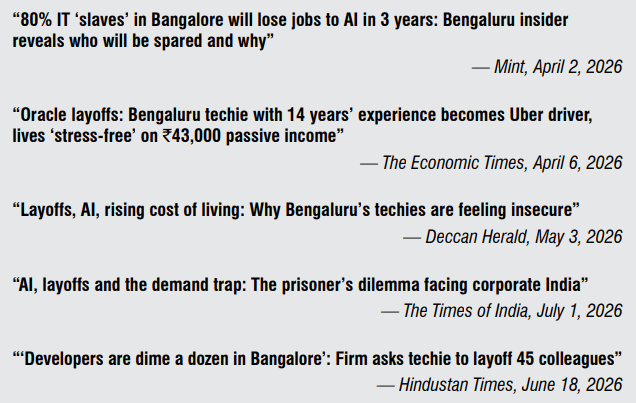
AI-driven restructuring is like a forest fire. It is not a judgement on you.
If you lost your job, it was not because of your inability. It was not because you were useless. It was the result of a major shift, and a major shift does not check merit lists before it arrives.
AI was already cooking before you were born!
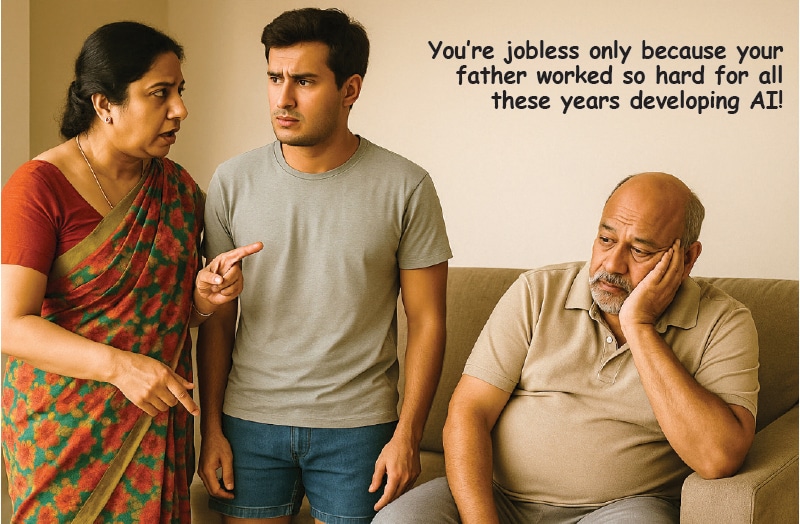
Of course, AI’s effects are new, but AI itself is not. The effort and pursuit began long ago, before many of us were even born (Fig. 2). That means we were born when AI was already cooking in the kitchen. Everyone had heard of it, some could even smell it, and a few even helped build it. But only a handful understood what would happen once it was ready to be served. That is why most people were caught unprepared. Perhaps this is nature’s own way of teaching us to stay vigilant.
This too shall pass
Let us not pretend this phase does not hurt.
It does.
The shock, the scramble, the financial stress, the EMIs, the loans, the obligations, the rent, and the sleepless nights are painful, exhausting, and emotionally draining. They test you. It will hurt, but this too shall pass. Stay strong. What matters most is what comes after this, because that stretch of your life may be much longer than this difficult phase, and it is still entirely yours.
So, before you do anything else, ask yourself one useful question: What was the downside of the job you just lost? Maybe losing it might actually help you explore uncharted territory and discover more of your potential. Maybe it is an opportunity to look beyond that job. Sometimes not getting what we want can become an opportunity to find something even better. Maybe you will discover opportunities you had never considered.
Perhaps this setback is pushing you to do what you always wanted to do but never had the chance or courage to pursue because of the comfort of the job you had. Maybe greater things are waiting for you.
If you are a recent graduate, or about to graduate, you still have time to rethink your options. Maybe it is time for some course correction. You may want to acquire different skills or choose different electives to stay relevant in the changing job market. The important thing is that not all is lost. You simply have to look again at your options instead of following the pre-set path you had been following until now.
You already proved yourself
Here is something worth remembering. It was you who got that job in the first place. It was you who walked into those interviews and passed them, meeting the standards someone else had set and competing against other candidates. Nobody handed you that seat out of pity. You earned it. Whatever it took to earn it is still inside you today.
If you had what it took then, you have what it takes now. Possibly more, because you have now been through something you had never faced before, and that experience itself is valuable.
Yes, it came suddenly. It may have caught you unprepared. But this is a short phase in a long life. Maybe next time you will be better prepared. Maybe you will value what you have differently. Maybe this will become the reason you finally focus on becoming more valuable rather than merely more comfortable. That is not a consolation prize. It is a lesson, and lessons are often worth more than the comfort they cost to learn.
Take your time. Think deeply
Do not rush into the first job title or business plan someone hands you. Give yourself real time to think. Talk to people who lift you up, not the ones who catastrophise with you over chai. Let your own thoughts settle before you act on someone else’s idea of what you should do next.
And ask yourself the question most of us stop asking somewhere in our twenties: What do you actually like doing? Not what pays the most. What would you choose to spend a full day on, even if nobody was watching or applauding? Take days to answer that question. It is an important one. Write it down, literally, on a piece of paper. State why you like it. Once you like something deeply, you will look forward to doing it. If you do it all the time, you excel at it. Once you excel at it, your services or products become far superior for users. If your services or products are far superior to others, you can charge a fee, or even a premium fee. If you can charge a fee for your services or products, you just found a way to convert your liking into a financial source.
Bring your expenses down first
Cash runway, not career strategy, comes first
The single most useful thing you can do right now is to bring your expenses down, way down, to the absolute minimum. There is no shame in that. Reduce your spending so your savings can stretch your runway. That gives you the freedom to take a calculated risk instead of a desperate one.
Lean on trust
Family, old colleagues, your local community—this is where real leads come from, far more often than a cold application into an already shrinking market.
Let go of what others think
A lot of good people stay stuck in a shrinking, dying lane far longer than the numbers justify, purely because leaving costs them status. Meet people. Let go of your ego, your prestige. Share your situation.
Now, think about a small income stream
Once your head is clear and your expenses are down, start thinking practically: how could you turn what you genuinely enjoy doing into a small income stream within days, weeks, or a few months? It does not need to be large to begin with. It simply needs to begin.
This need not be another desk job. These are businesses built on trust and personal relationships. They run on reputation and word of mouth. Many people hesitate to take up work that is not seen as glamorous as being a software or hardware engineer. In reality, you can choose almost any profession and make it better by applying the technology you already know—or can learn. That helps you stand out from people who have been doing it for years. There are no ‘levels’ to worry about in a job; the only questions are: Can you do it better than others, do you like doing it, can you get paid for it even a little to start with, and can you expand it over time? Leave behind the status, title, or position you held before. Look at some of the following examples and see if you can start and scale them to bigger heights.
Small starts, real trust
- Food and beverage—A kebab stall, filter coffee counter, tiffin service
- Home services—Electrical work, interior fit-outs, appliance repair
- Land and nature—Gardening, landscaping, small-scale agriculture
- Guidance and travel—Local trekking or heritage tour guiding
- Local commerce—A small marketing agency or neighbourhood real estate practice
You may want to try it. And know, truly, that it is fine if it fails. At least it sheds the inhibition you might have. It removes that ‘stage fear’ and enables you to uncover your strengths.
Vinod Khosla, who went on to co-found Sun Microsystems and later built one of the most successful venture funds in the world, did not start with success. In 1975, fresh out of IIT Delhi, he tried to start a soy milk company, a milk alternative for Indian households that had no refrigeration. It failed. Funding did not come through. Infrastructure worked against him at every step; the waiting time to get a phone connection was seven years back then.
That failure did not define Vinod Khosla. It redirected him toward Carnegie Mellon, toward Stanford, toward Silicon Valley, toward everything that came after. The lesson is not that failure guarantees success later. It is that even the most capable people’s first tries commonly fail, and the failure itself carries no verdict about the person.
The lesson you already learned once
Think about something even closer to home than Khosla’s story. You would not be walking today if you had been afraid of falling while learning to walk. You fell many times as a child. By any definition, those were failures. But you were not ashamed then. You did not wait for someone to applaud before standing up again. You did not give up because you fell. You never stopped to wonder what others thought. That child within you already knew how to do this. Your task now is simply to remember.
In summary, every shake-up, shock, and disruption is an opportunity to bring out the best in you. Take time to think clearly. Find what you genuinely enjoy. Turn it into something small and real. Do not give too much importance to what others think; this is one of the most important lessons in our closely knit societies. Expect a stumble or two along the way. Then get up anyway, exactly as you did before.
You are not alone. Thousands, or even millions, may be going through this right now. As wise people have often said, “Dream big, everything else will fall into place.”
Janardhana Swamy is an electronics engineer, inventor with patents in India and the USA, and a former Member of Parliament from Chitradurga. This series draws on his rare blend of technical depth, global experience, and lifelong passion for India’s leadership.