

Reference design provides a compact, high-density buck-boost battery-charging platform for notebook and portable applications.
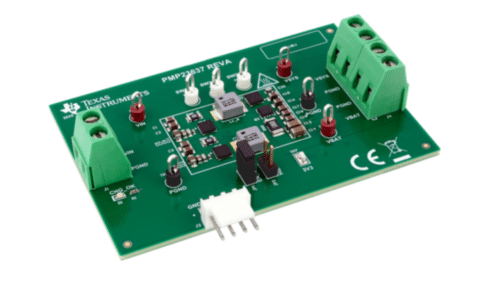
Texas Instruments has developed a compact dual-phase multi-cell battery charger reference design for notebook PCs and portable electronic devices. The design supports batteries with two to five cells and uses a quasi-dual-phase buck-boost charging architecture. It is intended for applications including standard notebook PCs, Chromebooks, Windows-on-Arm devices and multimedia tablets.
The reference design supports a wide range of input sources, including universal serial bus (USB) adapters, high-voltage USB-C power delivery sources and conventional power adapters. The listed design operates from a DC input range of 3.5V to 20V and provides a nominal output voltage of 14V, with an output current of up to 17A and output power of up to 238W.
The dual-phase topology uses two small inductors and two half-bridge dual field-effect transistors. This arrangement helps distribute heat across the board and minimise thermal hot spots. The design delivers up to 240W of charging power and achieves a peak efficiency of 98.2 per cent, supporting high-power operation in a compact form factor.
The charger is implemented in a compact board measuring 19.1 mm × 29.2 mm. Dual field-effect transistors housed in 3.3 mm × 3.3 mm packages contribute to the high-density implementation, while the dual-phase architecture supports improved thermal performance by spreading power dissipation across the board.
Texas Instruments provides design resources including a test report, assembly drawing, bill of materials, CAD/CAE files, Gerber files, PCB layout data and schematic diagrams. The fully assembled board is intended for testing and performance validation and is not available for sale. These resources can help engineers evaluate and adapt the dual-phase battery-charging architecture for high-power portable electronic systems.
For more information, click here.