




A 500W onboard charger reference design uses gallium nitride transistors to enable electric two-wheelers to charge from standard AC outlets without specialised charging infrastructure.
Renesas has introduced a 500W onboard battery charger reference design aimed at electric two-wheelers such as scooters and motorcycles. The design places the charger inside the vehicle, allowing the battery to be connected directly to a standard AC outlet without depending on a dedicated charging station.
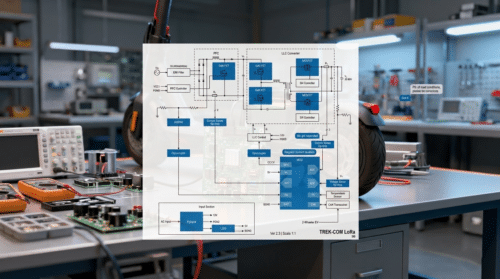
The reference design uses two power-conversion stages. An input power factor correction (PFC) stage converts the incoming AC supply into a regulated DC bus, after which an LLC resonant converter reduces the voltage to the level required for battery charging. Renesas reports peak efficiency above 95% for the LLC DC-to-DC stage. The design accepts a universal AC input, making the same architecture suitable for different mains-voltage environments. Engineers can also interact with the reference hardware remotely through Renesas’ Lab on the Cloud platform, which provides a PC-based graphical interface for evaluation.
At the heart of both the PFC and LLC stages is the TP65H070G4PS, a 650V GaN FET with 72mΩ on-resistance in a TO-220 package. Its switching characteristics and lower losses are intended to improve conversion efficiency while allowing the power stage to remain compact. This can help with thermal management in the confined space available for onboard charging electronics.
An RL78/F14 microcontroller handles control and vehicle-side communication. The 8/16-bit automotive MCU includes a CAN controller, with an external transceiver providing the physical CAN interface. The controller can communicate information such as battery condition and load connection or disconnection events to the vehicle’s electronic systems.
The design also includes the RAA223181, a 900V offline flyback regulator that supplies the low-voltage auxiliary circuitry separately from the main charging path. The regulator drives an isolated flyback supply, while the final isolation performance depends on the transformer, PCB layout, creepage and clearance distances and the selected insulation system.
Renesas provides the reference design with schematics, bill of materials and PCB layout information. The hardware can also be evaluated remotely through Lab on the Cloud, allowing engineers to examine the design without initially requiring access to a physical board. The platform provides a starting point for developing compact onboard charging systems for electric two-wheelers.
For more information, read the official announcement.

