A reference platform allows you to compare wired and wireless battery management architectures for EV battery packs with cell monitoring, balancing, and communication support.
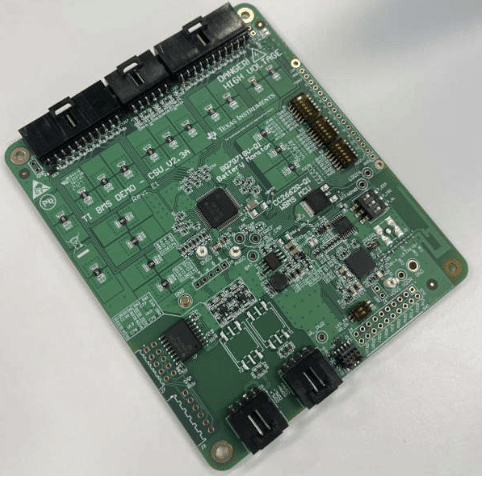
Texas Instruments (TI) library has a reference design (TIDA-020076) for evaluating wired and wireless Battery Management System (BMS) architectures in high-voltage battery packs. The design implements a cell supervision unit that supports up to 18 cells per module and allows multiple modules to be daisy-chained for battery systems used in passenger cars, commercial vehicles, and two- and three-wheelers operating above 72V.
The platform supports both wired and wireless interfaces, giving design engineers a way to compare communication architectures, power configurations, and system scalability within the same evaluation setup. The design also supports two power supply methods, LDO and DCDC, enabling analysis of efficiency, component count, and current consumption tradeoffs before production implementation.
The wired BMS architecture targets large-format lithium-ion battery packs. Each module supports up to 18 cells with a maximum operating voltage of 100V. Up to 35 modules can be connected in a stack, allowing support for battery packs with as many as 560 series-connected cells.
The board integrates cell monitoring, protection, balancing, diagnostics, and communication functions. Communication between stacked modules uses an isolated daisy-chain differential bus, while synchronized communication and precision voltage measurements support more accurate estimation of State of Charge (SOC) and State of Health (SOH). Faster sampling and accurate cell voltage measurements also help improve battery operation and balancing performance.

The design includes independent protection circuitry and supports fast cell balancing across stacked modules. Engineers can evaluate system behavior through a PC-based GUI that provides access to cell monitoring configuration, analog channel data, balancing control, and fault diagnostics. Communication between the PC and the base module uses a USB2ANY UART interface.
System specifications include an operating voltage range from 9V to 100V, support for cell voltage measurements from 1V to 5V, and an operating temperature range of –40°C to 125°C.
For wireless evaluation, the design combines a battery monitor with a wireless MCU. Battery monitoring data is transmitted through a 2.4GHz Wireless Battery Monitoring System (WBMS) communication protocol, reducing the wiring required in EV battery packs.
The wireless approach enables battery monitoring and control without physical communication cables by using RF-based communication. Reducing wiring can lower system weight and complexity while simplifying system expansion and maintenance. The design also allows engineers to evaluate wireless communication reliability and power management in distributed battery architectures.
The wireless section uses an LDO to generate a 3.3V supply for the wireless MCU. The input can be sourced either from LDOIN or from the battery monitor supply rail.
For powering the battery monitor, the design supports both LDO and DCDC configurations. The integrated LDO approach requires only an external transistor, reducing component count and simplifying implementation. The DCDC option provides higher efficiency and lower quiescent current for applications where lower power consumption is required. In these configurations, a DC/DC converter supplies power through the LDOIN pin.
The reference platform is intended for engineers evaluating wired versus wireless BMS architectures, scalable cell monitoring, power supply design choices, and communication methods in high-voltage EV battery systems.
TI has tested this reference design. It comes with a bill of materials (BOM), schematics, assembly drawing, printed circuit board (PCB) layout, and more. The company’s website has additional data about the reference design. To read more about this reference design, click here.