
The Game Boy, the legendary gaming console of the 1990s, still holds a special place in the hearts of gamers. Its simplicity, durability, and timeless design transformed it from a mere device into an enduring symbol of portable gaming.
An earlier design iteration explored a Game Boy-inspired device based on the ESP8266, featuring both colour displays and OLED screens. Although the concept functioned well, it did not fully align with the intended vision, prompting a complete redesign from the ground up.
POC Video Tutorial
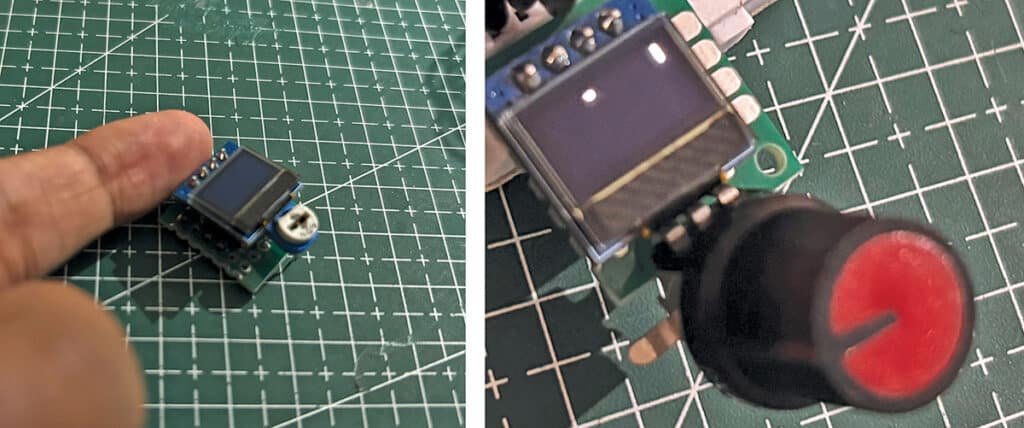
This time, the goal was far more ambitious: to create a next-generation micro Game Boy built with cutting-edge technology. The emphasis was on ultra-miniaturisation, energy efficiency, and genuine portability. The result is one of the smallest game systems ever conceived, measuring just 1.5cm, compact enough to sit comfortably on a fingertip. It can be worn as a locket or carried as a keychain while still running custom games.
What truly distinguishes this design is its innovative energy system. The device can operate directly from a small solar cell rated as low as 30mA at 2.1V-2.7V, or function entirely without a battery using a supercapacitor. Just a few seconds of charging can power the system for several minutes, enabled by efficient power management and the long cycle life of supercapacitors.
Despite its remarkably small size, the system remains fully programmable, allowing custom games to be created, modified, and run with ease. Sustainability, innovation, and nostalgia come together in a single ultra-compact design. More than just a miniature gaming device, this system reimagines the Game Boy for the future. The author’s prototype is shown in Fig. 1, while the components required to build the system are listed in the Bill of Materials table.
| Bill Of Materials | |||
| Component | Name | Description | Quantity |
| Supercapacitor | C1 | 2F, 2.7V | 1 |
| Schottky diode | D1 | 1N5817-TP | 1 |
| Potentiometer | R1 | 10k | 1 |
| ATtiny85 | U1 | ATTINY85 | 1 |
| 0.49-inch (1.2cm) OLED | U2 | SSD1315 OLED | 1 |
| Solar cell | U3 | 2.7V, 30mA-50mA | 1 |
| PCB | — | Printed circuit board | 1 |
Batteryless Gaming Console Circuit and working
Fig. 2 shows the circuit diagram of the batteryless Game Boy. The system is built around a supercapacitor (C1), a Schottky diode (D1), a potentiometer (R1), an ATtiny85 microcontroller (U1), a 0.49-inch (1.2cm) OLED display (U2), a solar cell (U3), and a few supporting components.