The GaN-based adapter design for power solutions. It has a modular setup, is efficient, has a wide voltage range, and is easy for engineers to customize. Read more!
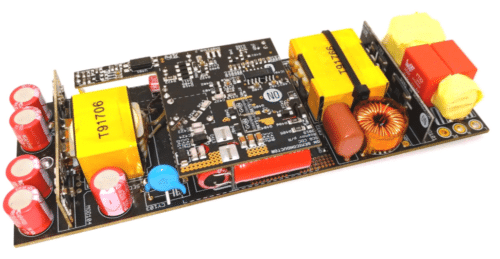
The NCP13992UHD300WGEVB from Onsemi is a GaN-based ultra-high power density adapter reference design that enables design engineers to create efficient, compact power solutions.
This reference design is a valuable tool for engineers developing high-performance power systems with a focus on key parameters like efficiency, no-load input power, transient responses, and EMI signature.
The design includes a Synchronous PFC boost converter operating in Discontinuous Conduction Mode (DCM) or Critical Conduction Mode (CrM) depending on load and an LLC power stage with secondary-side synchronous rectification.
The NCP1616 controller in the PFC front stage ensures a unity power factor and low input current THD, while the NCP4306 high-performance SR controller synchronizes the PFC boost SR switch.
The LLC stage operates at 500 kHz under nominal load, managed by the NCP13992 current-mode LLC controller. GaN HEMTs in both power stages maintain high efficiency at high frequencies.
GaN Systems’ GS66504B are used as primary-side switches. The secondary side’s synchronous rectifier includes the NCP4306 controller and two paralleled 60V power MOSFETs per branch, implemented on a dedicated SR MODULE daughter card for efficient PCB design.
Ultra-high power density is achieved through the modular design, controllers, drivers, GaN HEMTs, and custom power magnetics. This manual focuses on the reference design, operation principles, and connections.
For detailed information, refer to the datasheets of the individual components used.
The key features of the design include a GaN HEMT-based design offering ultra-high power density of up to 32 W/inch³, a simple two-layer PCB design for all board modules, and a maximum power of 300 W with peak power reaching up to 340 W at a fixed output voltage of 19 V.
It supports a wide input voltage range of 90-265 Vrms, incorporates synchronous CrM PFC using GaN HEMTs, and features a 500 kHz LLC stage with a 600 V HB GaN driver and a high-performance current mode LLC controller. Additionally, it complies with CoC5 Tier 2.
The demo board uses a modular system consisting of the main board and several daughter-card modules. The following daughter cards are inserted into the main board: bridge rectifier module, CBULK module, LLC stage module and SR module.
The modular design offers several advantages, including versatility, the ability to test custom daughter cards, easy design updates, checking individual module functionality, and space for additional features. This approach helps reduce PCB area, increase power density, and minimize the required PCB layers.
All PCBs are designed as two-layer boards with 70 µm copper plating for improved thermal management and reduced conduction losses, especially on the secondary side, which carries a relatively high output current.
Onsemi has tested this reference design. It comes with a bill of materials (BOM), schematics, assembly drawing, printed circuit board (PCB) layout, and more. The company’s website has additional data about the reference design. To read more about this reference design, click here.