




The design enables precise measurement of high AC currents while maintaining electrical isolation between the sensing and measurement circuits.
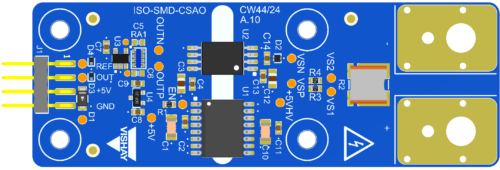
Applications like EV powertrains, battery monitoring systems, charging stations, and power supplies need a proper measurement of the current while ensuring that electrical isolation is maintained. This reference design, developed by Vishay, allows isolated AC current measurement up to ±54A continuously and can work at an isolation voltage up to 1200VRMS. In addition, it can produce an isolated single-ended analog output between 0V and 2.5V, thus enabling its use with monitoring and control systems.
The design measures current by sensing the voltage drop across a low-resistance shunt resistor in a high-voltage environment. The amplifier used in the design can provide a linear differential input signal in the range of ±50mV and a differential output signal range of ±2.05V.
The differential signal generated through the isolation stage is transformed into a single-ended signal output that can be directly connected to a single-ended ADC or multimeter. The transformation stage makes it easy for the generated signals to be processed and makes it easy for the obtained current values to be employed by monitoring, control, and protection systems.
In order to enhance the precision of measurements, the design employs a low-pass RC filter prior to the isolation stage. This is achieved through the choice of resistors whose function is to minimize voltage drops through input bias and ensure impedance balance between the positive and negative inputs. Moreover, ESD protection is employed to protect the isolation stage from transient voltages.
The sensing component is made of all-welded structure, and it exhibits low resistance, low inductance, low thermal electromotive force, and sulphur resistance. The sensing element is automotive qualified applications and has low temperature offset and gain drifts.
This reference design has a bandwidth of about 280kHz which makes it possible for the reference design to measure rapidly changing current signals. It is designed for use in applications such as motor control systems, power supplies, battery management systems, chargers, and EV powertrains.
Vishay has tested this reference design. It comes with a bill of materials (BOM), schematics, assembly drawing, printed circuit board (PCB) layout, and more. The company’s website has additional data about the reference design. To read more about this reference design, click here.


