Build factory automation systems with an eight-port IO-Link gateway that connects devices and supports multiple industrial communication networks.
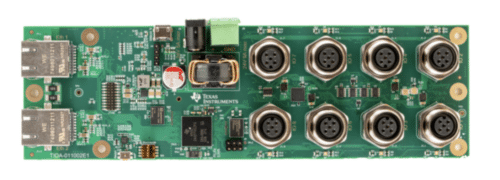
As factories add more sensors, actuators, and smart devices, design engineers need communication systems that can connect many field devices while maintaining fast and reliable data exchange. TIDA-011002 reference design from Texas Instruments (TI) provides a ready-to-use platform for developing IO-Link controller gateways that can simplify product development and reduce design time.
The design implements an 8-port IO-Link gateway that supports COM3 communication with cycle times of up to 400 µs. Each port can supply up to 1 A on the L+ line, allowing it to power a wide range of IO-Link devices. In addition to the IO-Link ports, the design includes an extra digital input/output (DI/DO), giving engineers more flexibility for connecting conventional digital signals.
One of the key advantages of the design is its support for multiple industrial Ethernet protocols. Using the microcontroller’s integrated Industrial Communication Subsystem (ICSS), the gateway can communicate through EtherCAT, PROFINET, EtherNet/IP, and Modbus TCP. This allows manufacturers to use the same hardware platform across different industrial networks, reducing the need for separate gateway designs for different customers or applications.
The hardware has also been tested to meet industry-standard EMI and EMC requirements. This helps engineers develop products that are more likely to meet compliance requirements during certification, reducing redesign efforts and speeding up deployment.

The reference design is based on an isolated architecture, helping protect both the controller and connected devices from electrical disturbances commonly found in industrial environments. The design uses isolated power supplies and digital isolators to separate the processor from the field side, improving system reliability and safety.
The processor manages communication with all eight IO-Link ports while simultaneously handling industrial Ethernet traffic. Dedicated IO-Link device transceivers simplify communication with field devices, while integrated power management circuits provide the required operating voltages for different sections of the board. The modular hardware architecture also makes it easier for engineers to adapt the design to products with different numbers of ports or additional features.
This platform is suitable for developing communication modules and stand-alone remote I/O systems used in factory automation. Typical applications include PLC expansion modules, distributed I/O stations, machine automation systems, conveyor controls, process automation equipment, and industrial sensor hubs that require reliable communication between field devices and higher-level control systems.
For design engineers working on industrial automation products, this reference design offers a practical starting point for building multi-port IO-Link gateways. By combining eight IO-Link ports, support for multiple industrial Ethernet protocols, isolated communication, and tested hardware into a single platform, it can help reduce development time while providing the flexibility needed for a wide range of industrial applications.
TI has tested this reference design. It comes with a bill of materials (BOM), schematics, assembly drawing, printed circuit board (PCB) layout, and more. The company’s website has additional data about the reference design. To read more about this reference design, click here.